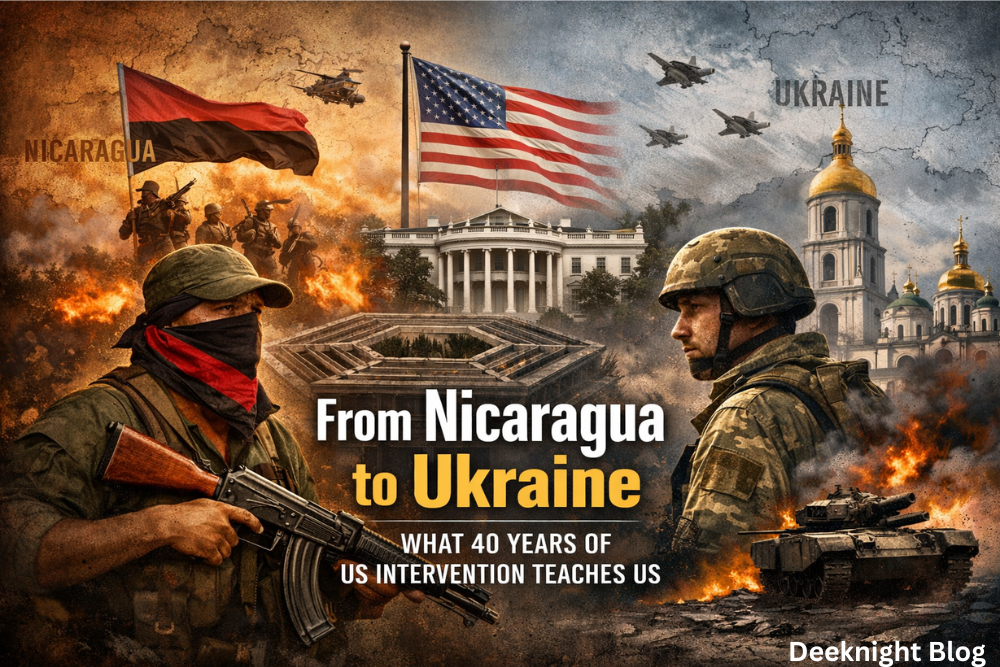
I lived with the Sandinistas in Nicaragua from 1987 to 1990. Those were not easy years. The US funded the Contras. Villages were burned, schools were attacked and the world was told a different story. Today I watched the war in Ukraine.
I see the same patterns, the same justifications and the same cost paid by ordinary people. This is not about comparing wars. It is about understanding how US intervention works across decades. And what we, as anti-war activists, must do differently in 2026.
The Sandinista Years: What I Saw First-Hand
When I moved to Nicaragua, the revolution was still fresh. The Sandinistas had won in 1979. They built literacy campaigns and improved healthcare. But Washington saw something else: a threat. The Reagan administration called them “communist proxies.” Sound familiar? Today, the same label is used for anyone who resists US foreign policy goals.
I met farmers who lost children to Contra attacks. I met nurses who worked without electricity. And I met US officials who denied funding death squads – while the evidence sat in open reports. That period taught me a core lesson: US intervention is rarely about freedom. It is about control, markets and strategic depth.
Fast Forward to Ukraine: Same Playbook, New Generation
In 2022, Russia invaded Ukraine. The US quickly rallied NATO. Sanctions were imposed and weapons were shipped. Now, in 2026, the war continues. Over 500,000 soldiers and civilians are estimated dead or wounded. Entire cities look like Grozny in 2000. But here is the hard question: Why did the US ignore Russia’s security concerns for 30 years? Why was NATO expanded again and again? I am not defending Putin’s invasion. That would be wrong. But I am asking for honest history.
The same honesty I tried to bring to my posts on US-China relations history and the Vietnam War draft resisters. When I wrote about peace and justice for 2026, I argued that we cannot have one without the other. In Ukraine today, justice means stopping the killing. But peace means addressing why the war started.
A Short Lesson from the Vietnam War Draft Resisters
In the 1960s and 70s, young Americans faced a choice. Go to Vietnam or resist. Thousands fled to Canada – where I lived from 1968 to 1974. I saw draft resisters build new lives. They were not cowards. They were moral actors. They asked: Why are we fighting? Who benefits? That question is forbidden today.
In the mainstream media, questioning US aid to Ukraine is called “pro-Putin.” That is a trap. A true peace movement must ask hard questions without being silenced. My earlier post on Vietnam War draft resisters explained how ordinary people stood up to the military machine. That lesson is more urgent now than ever.
The Economic Truth: Who Pays for Endless Intervention?
Let me be honest with you – writing these posts is not easy. But I keep going because I believe in building a real alternative to war. That is why I wrote “A Realistic Path to Peace: Rethinking War, Power and Global Responsibility”. In that book, I define exactly how ordinary people can break the cycle of US intervention.
I show why military solutions never work and what we must do instead. The book draws directly from my years in Nicaragua, my time with Vietnam War draft resisters in Canada and my decades of watching Washington start wars it cannot win. If you want one place to understand my full argument for peace and justice, that book is it.
In 2024 alone, the US sent over $60 billion in military aid to Ukraine. That is more than the entire education budget of many states. Meanwhile, US infrastructure is crumbling, housing is unaffordable and veterans sleep on the streets. Does that sound like a country that cares about “defending democracy”? The answer is no.
And that is why understanding US-China relations history becomes critical – because the same military-industrial complex that profited from the Cold War is now pushing for a new one with China.
Why the US-China Tensions Follow the Same Script
In my post on US-China relations history, I wrote that war is not inevitable. But provocation makes it likely. The US has over 800 military bases worldwide. China has one foreign base (in Djibouti).
Yet the US media calls China “expansionist.” Taiwan is the new flashpoint. The US sells weapons there and sends warships through the strait. Then it blames Beijing for reacting. This is the same logic used against Nicaragua, against Vietnam and against Iraq. If you do not learn from history, you repeat it – with more powerful weapons.
This is exactly why I wrote “Befriending China: A Complete Guide to People-to-People Peacemaking, Travel, Culture and Modern Achievements“. Most Americans have never met a Chinese person. They only see what the Pentagon and corporate media show them – which is fear and lies.
My book is a practical guide to breaking that cycle. I explain how to travel to China, how to understand its culture and how to build people-to-people connections that no politician can break. If you truly care about US-China relations history and want to prevent the next war, start by befriending the Chinese people. That book shows you exactly how.
Peace and Justice in 2026: What Must Change?
Here is my answer after 40 years of watching US intervention. First, stop labeling every conflict as “good vs. evil.” Real life is complex. Wars have multiple causes. Ignoring that only prolongs suffering. Second, bring back draft resistance education. Young people today do not know their rights.
They do not know they can refuse to fight. We need modern guides – like the ones written for Vietnam War draft resisters – updated for the cyber-war era. Third, fund diplomacy, not drones. For every $1 billion spent on war, we could fund 20,000 teachers, build 5,000 hospital beds or plant 10 million trees.
Let me also recommend my memoir “My Whirlwind Lives: Lessons from Decades of Activism and Resistance“. In that book, I take you from my four months in a Jesuit seminary in 1964, to my six years in Canada during the Vietnam War draft resistance, to my three years with the Sandinistas in Nicaragua and finally to my life in New York City.
I do not hide my mistakes or my doubts. I share what worked and what failed. If you want to understand why I believe peace and justice are still possible, read that book. It is my life, my education and my hope – all in one place.
What You Can Do Today
You do not have to move to Nicaragua or Canada. But you can start small. Share this post with one friend who thinks war is the only answer. Follow independent journalists covering Ukraine, Gaza and Taiwan from the ground. Join a local peace group – many are reviving after years of silence. Ask your representatives: How much more weapons money before negotiations? Small actions create pressure. Pressure changes policy. I learned that in Nicaragua.
I saw it with the Vietnam War draft resisters. And I believe it for peace and justice in 2026. Also, educate yourself on US-China relations history because that will be the next big battlefield – not just militarily, but in media, trade and public opinion. If Americans believe China is the enemy, they will accept another endless war. Do not let that happen.
Recommended Stories
If you found this post valuable, here are four related stories from my blog that dive deeper into the themes we just explored:
- The True History of Vietnam War Draft Resisters Made Simple – A detailed look at how ordinary Americans refused to fight an unjust war and what their courage teaches us about resistance today.
- Peace and Justice in 2026: From Global Crisis to Collective Action – My roadmap for building a world where peace is not just the absence of war but the presence of justice.
- My Whirlwind Lives: Lessons from Decades of Activism and Resistance – A personal journey from Canada to Nicaragua to New York, sharing the raw lessons from a lifetime of standing against empire.
- The Actual History of the US-China Relations War Co-operation and a Way Forward – An honest, myth-busting account of the most dangerous relationship in the world today and how we can choose cooperation over conflict.
Final Words from Dee Knight
I am not a politician or a pundit. I am an old activist who lived through CIA-funded wars, saw revolutions crushed and watched new generations inherit old lies. The war in Ukraine will end one day. The US-China tension may or may not explode. But our job remains the same: Speak truth. Refuse to fight. Build alternatives. That is what I tried to do in 1987. That is what I try to do on this blog. And that is what I ask you to do now.
Dee Knight lived in Nicaragua during the Contra War, Canada during the Vietnam War draft resistance and New York City since 1974. He writes about US-China relations history, peace and justice and lessons from the Vietnam War draft resisters.
FAQs
Q: What is this blog post about?
A: Dee Knight compares US intervention in Nicaragua (1980s) with the Ukraine war (2026), sharing lessons from his personal experience as an activist.
Q: Who is Dee Knight?
A: A peace activist who lived with Sandinistas in Nicaragua, supported Vietnam War draft resisters in Canada, and writes on US-China relations and global justice.
Q: Which books by Dee Knight are Written?
A: Three books: Befriending China, My Whirlwind Lives and A Realistic Path to Peace.
Q: Does this post support Russia or Putin?
A: No. It criticizes all war and asks honest questions about why conflicts start and who benefits.
Q: How can I apply these lessons today?
A: Share the post, join local peace groups, read independent journalism and ask your representatives to fund diplomacy over weapons.