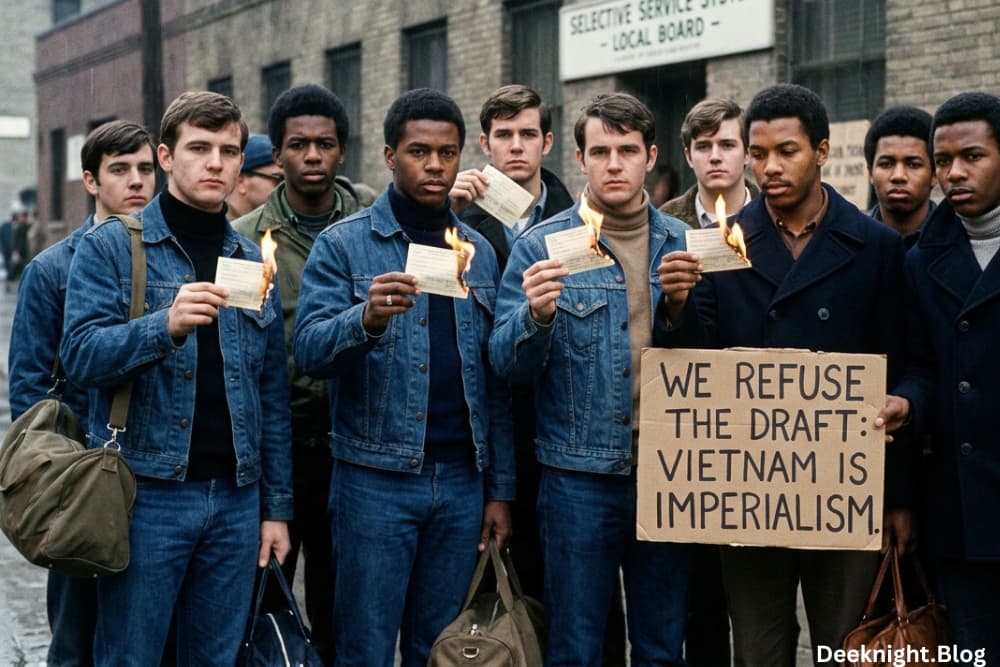
The Vietnam War is one of the most debatable events in American history. As much as textbooks usually dwell on the battles that took place in the jungles of Southeast Asia, a major war was also being fought at the home front. It was the battle of the draft resisters in the Vietnam War as thousands of young men decided to say no to a war that they felt was unfair.
It is not only the past that has to be looked at to understand this movement. It is the knowledge of how powerful the conscience is and how brave it is to be against the stream of imperialism.
What was the Draft in the Vietnam War?
The 1960s and the early 1970s in the United States government employed a system known as the Selective Draft to enlist young men into military service. This was popularly referred to as the draft. Getting a draft notice to most people was a decision where they had to either go and fight in a war they might not have been supportive of or they had to face the consequences of not doing so.
Between 1964 and 1973 close to 2 million men were drafted. But when the numbers of the casualties increased and the causes of the war started to be questioned, a huge tide of opposition started and was gaining momentum.
Why Did Men Not Like Being Drafted?
The causes of opposition to the draft were as many as the men. Others were motivated by religions, and others were inspired by politics against American imperialism.
Ethical and Moral Reasons.
A great number of resisters were conscientious objectors. They thought that it was essentially wrong to kill another human being irrespective of the reason. They believed that being involved in the war in Vietnam would be a breach of their most fundamental moral ideals.
Political Opposition
A large number of young men saw the Vietnam War as an imperialist project. They did not see the war as a struggle against slavery, but as an effort to be involved in a civil war that was not the business of the United States. This view is one of the essential ones discussed in Deeknight.blog where the history of anti-war activism is written in the form of eyewitness testimonies.
Racial and Social Injustice.
The draft was skewed towards low-income groups and people of color. Some of them claimed that it was hypocritical to expect Black men to go and fight in pursuit of democracy in other countries yet they were not even given basic civil rights in their own country.
The Three Lines of Defiance.
When one of the young men concluded he could not in good conscience fight in Vietnam. There were usually three choices available to him. The two ways had their share of danger and difficulty.
1. Conscientious Objection
One of the ways out was to legally apply to become a conscientious objector (CO). However the requirements were strict. You were required to demonstrate that your objection was founded on religious training and belief. In the early years political or philosophical objections were often rejected by draft boards.
2. Going Underground or Prison.
Other men opted to remain in the U.S. yet declined to report to be inducted. This proved to be a risky road that saw them end up in FBI manhunts and years of federal prison. It demanded that they needed to have a full break with their previous lives, and most times adopted new names to prevent detection.
3. Seeking Refuge Abroad (The “Draft Dodgers”)
Estimates suggest that between 30,000 and 100,000 Americans crossed the border into Canada or fled to Europe to avoid the draft. Although the media tended to refer to these men as draft dodgers as an insult, these men considered themselves political exiles. They abandoned their families careers and nation to uphold their sanity.
Personal Perspective: A Whirlwind of Resistance
The personal stories of people who experienced it are what one can do to gain a better idea of the weight of these choices. Dee Knight, the writer of My Whirlwind Lives was among them who decided to fight back. He took the life changing move to Toronto, Canada in 1968 after he was threatened with the possibility of being deployed to Vietnam.
His journey was not just about avoiding a war; it was becoming a part of a movement. In Canada draft resisters formed support networks, newspaper publications and organized their own draft resisters. This was the time of political awakening. The exile as explained in his book led to a lifetime of service with peace and justice.
The Effect of the Resistance Movement.
The draft resistance movement was significant in the termination of the Vietnam War. The system had become uncontrollable by the late 1960s.
- Logistical Failures: There were too many men struggling or making claims of CO status to be processed in the legal system.
- Changing Public Ideas: The courage of the resisters compelled the American people to rethink the righteousness of the war. It was a great panic to see the boy next door prefer the prison or exile to the battlefield.
- Termination of the Draft: The draft was officially abolished in 1973, and the U.S. switched to an all volunteer military, in part due to the fact that the draft had become a domestic rallying point.
Recommended Stories:
- Befriending China: A Complete Guide to People-to-People – Explore how diplomacy can replace conflict in modern U.S.-China relations.
- Imperialism in the Twenty-First Century – Understanding how global power dynamics have evolved since the Vietnam era.
- Peace and Justice in 2026: From Global Crisis to Action – A deep dive into current movements for social and political change.
- The 15-Point Peace Proposal: Can Diplomacy End War? – Analyzing the latest efforts to bring stability to global conflict zones.
Resistance to a Realistic Path to Peace.
The experience of the Vietnam years is still applicable in 2026. World wars keep on happening and the war machine tends to look invincible. Nevertheless, draft resistor history demonstrates that personal conscience can be used to oppose the state.
In his later treatise A Realistic Path To Peace—Dee Knight uses these lessons of the past to draw a prospective situation in which interventionism is replaced by diplomacy. The main message is the same: peace does not only exist in the absence of war, but in the existence of justice and the unwillingness to engage in oppression.
The Heritage of the Resisters.
In 1977, President Jimmy Carter gave a blanket amnesty to individuals who had dodged the draft in the Vietnam War. This enabled thousands of exiles to go back home. Nevertheless, the wounds of that period were still present.
To say no was the choice of many resisters that determined the rest of their lives. They turned out to be the organizers, writers and activists. Who still struggled against subsequent intervention in Central America, the Middle East and elsewhere.
The actual history of draft resisters in the Vietnam War is the history of courage in the face of pressure. It reminds us that despite the government requiring obedience the final power is that of conscience.
To explore more in-depth articles on history, modern imperialism and activism visit the commentary sections at Deeknight.blog. Where the legacy of these movements continues to be analyzed and kept alive for a new generation.
Frequently Asked Questions (FAQs)
Q: What were the draft resisters of the Vietnam War?
A: Vietnam draft resisters referred to men, who declined to be inducted into the military between the years 1964 and 1973. Motivated by a moral or political protest against imperialism, they preferred prison, underground life or exile to the fight in an unjust war.
Q: Does draft resisting mean draft dodging?
A: Avoiding service is commonly a pejorative description of draft dodging. Resistance suggests an active, political anti-war and anti-state position, which is one of the central themes of My Whirlwind Lives by Dee Knight.
Q: What is the number of Americans who visited Canada to dodge the draft?
A: It is estimated that 30,000 to 100,000 Americans escaped to Canada. This marked the greatest political exodus since the history of the U.S. building a giant anti-war base of supporters in cities such as Toronto and Vancouver.
Q: Have the Vietnam draft resisters ever been pardoned?
A: Yes. President Jimmy Carter would pardon all draft resisters of the Vietnam era in 1977 with an unconditional pardon. This enabled thousands of exiles to come back to the U.S. and not be charged with a court of law or time in prisons.
Q: What is the significance of draft resistance in our time?
A: It demonstrates that war machinery can be questioned by an individual conscience. This history offers a Realistic Path to Peace in 2026, demonstrating how grassroots opposition can effectively transform domestic and foreign policy in the world.