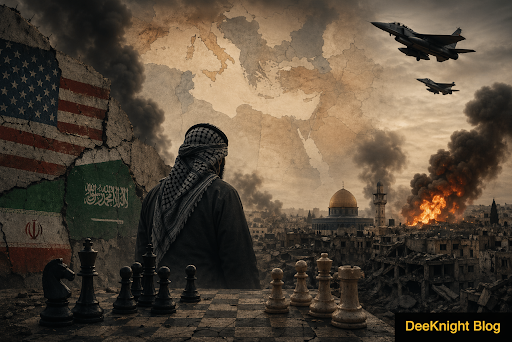
The Middle East is the region that has been in the limelight of the world over decades and is usually linked with war, insecurity and political instability. This causes many to pose one straightforward yet solemn question! Why is the Middle East at war all the time?
The fact is that there is no one reason. It is not merely about religion. It is not merely about a country or a leader. History, political choices, regional ambitions and world power interests that have accumulated over time determine the reality.
This will require us to read beyond what the headlines tell us. And examine the underlying forces that still dominate the region.
The Middle East is historically unstable and has been since the beginning of history.
A lot of the conflict today can be traced back to the early 20th century. Following the collapse of the Ottoman Empire. During this period, European powers split the region into new nations. With boundaries that were not determined by cultural, ethnic or tribal facts but political interests.
Consequently, numerous contemporary states of the Middle East were formed with highly mixed populations. That could not necessarily have a single identity or political apparatus. This led to internal tensions. Which were later to result in political and military conflicts.
Some of the conflicts also involve religion such as the Sunni and Shia split. Nevertheless, simplifying the whole scenario to religion does not take into consideration other significant aspects such as governance, foreign influence and resource competition.
The Reason Why Conflicts Persist in Contemporary Times.
Even nowadays, the situation in the Middle East remains in conflict. Because of a mixture of interdependent problems:
- Weak institutions and political instability in certain countries.
- Long-standing regional rivalries.
- Scramble of precious resources, particularly oil.
- The continuous influence of external powers in the world.
- Unresolved historical grievances.
These problems do not exist in isolation. They are interconnected and mutually supportive. This is the reason why wars in the area will take years or even decades.
Though active wars are slackened, the internal tensions tend to persist even during the slackening period. With a possibility of new conflicts erupting in the future.
The Middle East and the War in the US.
One of the most controversial issues of modern history is the role of the United States in the Middle East. The U.S. has participated in numerous military and political activities in the region. Wars in Iraq and Afghanistan during the last several decades.
The rationale of this engagement has been diverse. Between fighting terrorism and ensuring the stability of the regions and safeguarding strategic interests. The results have however been highly debated.
They say U.S. intervention has assisted in averting greater dangers and assisted allies in the area. Other people feel that it has at times increased instability and led to long-term conflict dynamics.
An even more profound insight into this can be had in My Whirlwind Lives. That reflects upon the effects of political choices and wars on the actual lives of people. It reveals how behind any policy or military act, there are individuals and societies that are severely impacted by the effects.
World Politics and the Middle East.
The Middle East is not a regional problem but one that is closely related to the politics of the world. The region has strategic interests of major world powers such as the United States, Russia and China.
These interests include:
- Energy and oil resources.
- Tactical and strategic location.
- Economic influence.
- Political alliances.
Due to this, local conflicts are frequently included in some bigger global rivalry of powers. This complicates the resolution process since there are several external players involved. And they have their objectives.
Rather than just local conflicts, most conflicts are affected or extended by international interests.
Why The whole world is involved in this conflict.
The Middle East might appear to be geographically remote to numerous individuals. But its influence is worldwide.
- The stability of the region affects oil prices.
- The regional conflicts influence global security policies.
- Wars and instability influence the migration patterns.
- Geopolitical tensions are responded to by international markets.
This implies that events that occur in the Middle East do not remain there. But rather affect economies, politics as well as societies across the globe.
Knowledge of this region does not only have to do with history. It has to do with knowing how the contemporary world is intertwined.
International Interactions and Other Viewpoints.
On top of the conflict is a wider debate on how international relations might be enhanced to decrease tension.
There are views that enhanced collaboration among the world powers may enable to curtail instability in the region. And others are concerned with the aspect of balancing competition and diplomacy.
This concept is discussed in Befriending China in terms of global cooperation and confrontation. It brings a significant question up. Whether, by spending more time on collaboration and less on rivalry, major powers would be able to minimize some conflicts in the course of time?
Although there is no easy solution, it emphasizes the role of international relations in the development of regional peace.
Why It Is So Hard to Have Peace in the Middle East.
It is very difficult to achieve a long-lasting peace in the Middle East. As the issues are very complex.
Even when one of the issues is handled, there are the others:
- Internal political divisions.
- External interference.
- Economic inequality.
- Mistrust of groups.
These are the aspects that complicate and slow down the resolution of conflicts. Even peace agreements in most instances are not completely effective in resolving underlying tensions which may reoccur later on.
Will the Middle East Ever be Stable?
Long-term stability does not have to be unattainable, in spite of the challenges.
To have a more peaceful future, it would probably be necessary:
- Powerful and participatory governance structures.
- Less foreign interference due to national interests.
- Local economic development that is socially advantageous.
- Diplomatic involvement at a long-term rather than military intervention on a short-term basis.
A Realistic Path to Peace dwells on such notions by examining viable strategies to harm conflict instead of examining its causative factors. It emphasizes the fact that peace is not a one-off event, but a process that needs to be continuously worked upon and collaborated.
Learning to see Conflict Beyond Politics.
Political analysis is not enough to completely get a picture of war and instability. Human experience has a significant contribution to the experience of feeling and remembering conflicts.
Politics can tell us the reason wars occur. But human stories can tell us their impact on the lives of ordinary people.
My Whirlwind Lives adopted this point of view, concentrating upon the human element of political and military choice. It assists in changing the perception of war. The abstract strategy into actual human impact.
Making a Step towards a Better Understanding.
The Middle East has been perceived in a tunnel of conflict. The truth is more complicated though. It is an area that has been influenced by history, world politics as well as human choices that are still in development.
The awareness of these factors does not have simple answers. But it gives clarity. And transparency is the initial step to fruitful dialogue and lasting solutions.
Final Thoughts
How come that the Middle East is always at war is not an easy question to answer. It is the outcome of numerous interrelated factors such as history, politics, world power, and unresolved tensions.
Conflict is not, however, the only tale. The area also signifies resilience, transformation, and potential of stability in the future.
Through getting to know the deeper causes, we are no longer on the surface assumptions but on a more informed view of the world.
As also discussed in the Deeknight blog, understanding these issues requires looking beyond headlines and exploring the deeper historical and political context behind global conflicts.
Recommended Stories
If you want to understand global conflicts in more depth, these related stories will help you explore different angles of war, politics and peace.
Each article connects with the bigger picture of Middle East instability and global power struggles.
- How Imperialism Shapes Modern Wars – Lessons from History and Literature
- From Gaza to Tehran: Lessons from the 2026 Middle East Crisis and Vietnam for Global Peace
- Is Peace Possible in the Middle East? A Realistic Path After the Gaza War
- A Realistic Path to Peace: Rethinking War, Power, and Global Responsibility
FAQs
Q: Why is the Middle East always at war?
A: The Middle East faces ongoing conflict due to history, political instability, regional rivalries, and global power involvement.
Q: What are the main causes of conflict in the Middle East?
A: Main causes include weak governance, oil and resource competition, foreign interference and unresolved historical tensions.
Q: Is religion the main reason for Middle East wars?
A: No. Religion is a factor, but politics, economics and foreign influence play a much bigger role.
Q: Why is the United States involved in the Middle East?
A: The U.S. is involved due to strategic interests, security concerns and past military interventions in the region.
Q: How does the Middle East conflict affect the world?
A: It impacts global oil prices, international security, migration and overall economic stability worldwide.