Introduction
The world changed fast between 1870 and 1914. European powers went on a colonizing spree. New countries like the United States, Japan, Germany and Italy joined them. Together they carved up almost all uncolonized land on Earth. This period is called the New Imperialism.
Old imperialism was different. Earlier colonizers mostly wanted coastal trading posts. They did not control large inland areas. But the New Imperialism brought entire continents under direct European rule. Africa was hit hardest. Large parts of Asia also fell.
The scale was huge. Colonial powers added about 240,000 square miles of new territory every year. That is nearly three times faster than before. By 1914 almost 85% of Earth‘s land was under colonial control.
Why does this matter today? Because modern borders, wars and poverty have roots in this period. Dee Knight explains in My Whirlwind Lives how decades of antiwar activism grew from fighting against imperial systems. That fight continues now.
This guide covers the definition timeline causes technology key events consequences and major theories of the New Imperialism.
What Is New Imperialism? A Simple Definition
New Imperialism is the name for a period of fast colonial expansion. It started around 1870. It ended with World War I in 1914.
This was not just more of the same old colonialism. Three things made it new:
- Speed – Land was taken much faster than before.
- Scale – Whole continents were divided up.
- Control – Europeans ruled directly not through local kings.
The goal was not just trade. The goal was full political control. Europeans wanted raw materials. They wanted markets for their factory goods. They wanted land for investment. And they had new technology to make it happen.
Timeline of the New Imperialism (1870–1914)
Here are the key dates:
Year Event 1870–1880s Expansion begins. Quinine and machine guns make interior conquest possible. 1873 Financial crisis pushes countries toward protectionism and colonies. 1876–1914 Scramble for Africa. European control goes from 10% to over 90%. 1884–1885 Berlin Conference sets rules for dividing Africa.1894–1895 First Sino-Japanese War. Japan became an imperial power. 1898 Spanish–American War. US takes Philippines, Puerto Rico and Guam. 1899–1902 South African War (Boer War). Britain fights Dutch settlers for gold and diamonds.1904–1905 Russo-Japanese War. First time an Asian power beats a European empire. 1914 World War I starts. Imperial rivalries are a major cause.
Old Imperialism vs New Imperialism
Many people think all colonialism was the same. That is wrong. Look at the differences:
Feature Old Imperialism (1500–1815) New Imperialism (1870–1914) Time16th to early 19th century Late 19th century to WW I Main goal Trade (spices gold slaves) and ports Raw materials captive markets investment Technology Sailing ships old muskets Steamships machine guns quinine railways telegraph Control type Coastal forts and trading posts Direct rule over huge inland areas Land added per year~83,000 sq miles~240,000 sq milesIdeology Mercantilism spread Christianity Social Darwinism White Man‘s Burden racial hierarchy Resistance outcome Indigenous people often won Europeans nearly always won
The Second Industrial Revolution changed everything. New machines needed new materials like rubber, copper and oil. Europe did not have enough of these at home. So Europeans went to Africa and Asia to take them.
Technology Made It Possible
People often forget how important technology was. Before the 1870s Europeans could scare coastal people. But they could not go deep into Africa or Asia. Two insects stopped them: the tsetse fly and the Anopheles mosquito. One carries sleeping sickness. The other carries malaria.
Quinine Changed Everything
Scientists learned that quinine could prevent malaria. Quinine comes from cinchona tree bark. European soldiers could now survive inland. The insects were no longer the best defenders of the jungles.
The Maxim Gun
The Maxim gun was invented in 1884. It was the first true machine gun. A small group of European soldiers could now kill hundreds of native fighters. Repeating rifles also helped. They fired much faster than old muskets.
Steamships and Railways
Shallow riverboats could go where sailing ships could not. Steel steamships moved bulk goods cheaply across oceans. Railways moved troops fast into the interior. These technologies made quick conquest possible.
The Telegraph
The telegraph allowed instant communication. A colonial governor could send a message to London and get an answer in hours. Before that it took weeks or months. Coordination became easy.
Economic Causes: Why They Really Did It
The New Imperialism was not an accident. It was driven by money and industry.
Hunger for Raw Materials
The Second Industrial Revolution needed new materials. Rubber for tires and wires. Copper for electricity. Oil for machines. Cotton for clothes. Steel for buildings and weapons. Europe had little of these at home. Colonies had plenty.
Surplus Capital Needed a Home
Factories made huge profits. Rich people had too much money to invest at home. British economist John Hobson explained this in 1902. He wrote a book called Imperialism: A Study. Hobson said domestic markets could not absorb all the surplus capital. So investors looked abroad. Colonies offered railways, mines and banks. Hobson called financial interests “the governor of the imperial engine.”
Captive Markets
European factories produced more goods than Europeans could buy. They needed more customers. Colonies were perfect because local industries were destroyed or banned. Africans and Asians had to buy European textiles, tools and weapons.
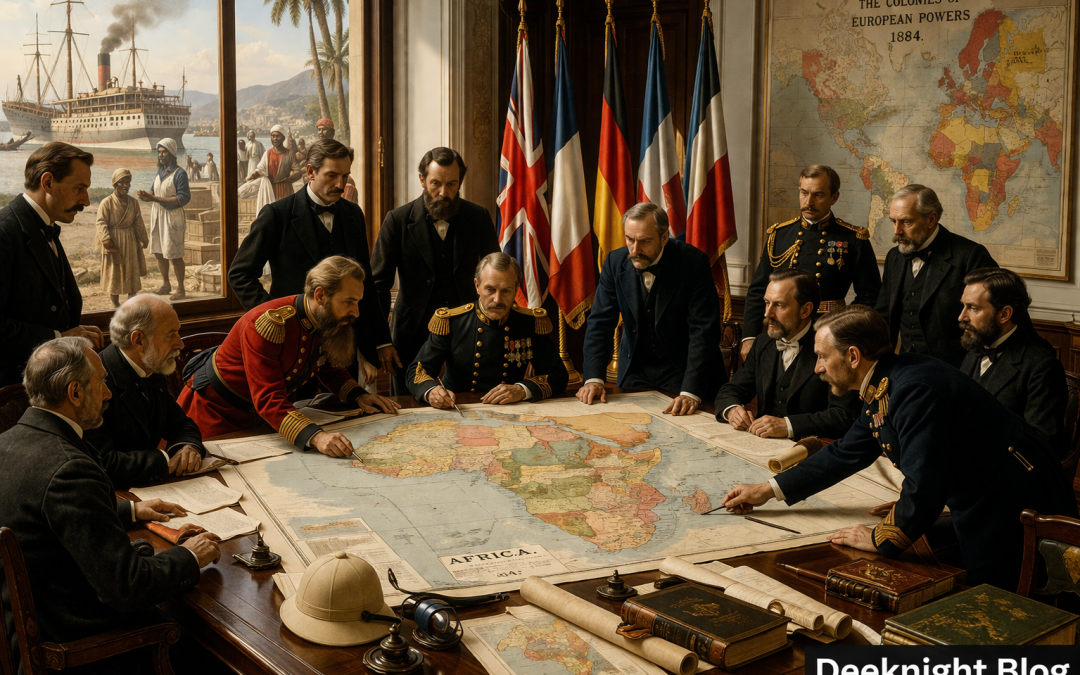
The Scramble for Africa
Africa was the most dramatic example. In 1875 Europeans controlled only 10% of Africa. By 1902 they controlled over 90%. This fast takeover is called the Scramble for Africa.
The Berlin Conference (1884–1885)
German leader Otto von Bismarck called a meeting. Fourteen European nations and the US came. No African was invited. They made two main rules:
- Effective occupation – You could only claim land if you actually controlled it.
- Notification – You had to tell other powers about your claim.
The Berlin Conference opened the floodgates. Every European power rushed to grab whatever was left.
Results of the Scramble
The consequences were terrible and long-lasting.
- Artificial borders were drawn without care for ethnic or linguistic groups. These borders still cause wars today.
- Brutal exploitation happened everywhere. In the Congo Free State King Leopold II of Belgium forced people to collect rubber. Millions died from murder disease and starvation.
- Economies were restructured to serve Europe. Africans grew cash crops for export instead of food for themselves.
- Resistance grew but was crushed with superior firepower. That resistance later became decolonization movements.
New Imperialism in Asia and the Pacific
Africa got the most attention but Asia also changed.
British India
India was the “jewel in the crown.” After the 1857 rebellion Britain took direct control. The British Raj ruled until 1947.
China Was Not Colonized but Controlled
China was never fully taken over. But European powers forced unequal treaties on China after the Opium Wars. They controlled ports, railways and trade zones. These were called “spheres of influence.”
Japan Became an Imperialist Power
Japan modernized fast after 1868. It then did what Europeans did. Japan beat China in the First Sino-Japanese War (1894–95). Then Japan beat Russia in 1904–05. That was the first time an Asian power defeated a European empire.
The Pacific Islands
The US took Hawaii in 1898. After the Spanish–American War the US also took the Philippines, Guam and Puerto Rico. Germany, Britain and France split most other Pacific islands.
The Americas
The Monroe Doctrine (1823) said Europe could not colonize the Americas anymore. This gave the US a free hand. After 1898 the US intervened many times in Cuba, Panama and other Latin American countries. The Roosevelt Corollary (1904) claimed the US had the right to be “international police” in the region.
Three Theories of Imperialism
Scholars have debated why the New Imperialism happened. Three thinkers stand out.
John Hobson – The Economic Taproot
Hobson was a British liberal. He said imperialism helped only a small group of rich financiers and industrialists. The nation as a whole lost money on colonies because wars and armies were expensive. But the rich class pushed for expansion anyway because they needed places to invest surplus capital. Hobson believed you could fix this with taxes and social programs. You did not need to destroy capitalism.
Vladimir Lenin – The Highest Stage of Capitalism
Lenin was a Marxist revolutionary. He agreed with Hobson about surplus capital. But Lenin said imperialism was not an accident. It was the natural final stage of capitalism. He wrote a famous pamphlet in 1917 called Imperialism the Highest Stage of Capitalism. Lenin said banks and industries had merged into “finance capital.” This finance capital needed to divide the world among monopolies. Rivalry between these monopolies caused wars. Lenin concluded that only socialist revolution could end imperialism.
Joseph Schumpeter – Atavistic Militarism
Schumpeter was an Austrian economist. He disagreed with both Hobson and Lenin. Schumpeter said capitalism is naturally peaceful and rational. Capitalism wants free trade not war. But old feudal warrior cultures did not disappear. Their values like honor conquest and militarism survived. These old instincts hijacked modern capitalism. Imperialism was therefore a leftover from the past, not something built into capitalism.
Consequences of the New Imperialism
The New Imperialism did not end with World War I. Its effects are still with us.
Immediate Consequences
- Rivalries between European powers got worse. These rivalries helped cause WWI.
- Infrastructure like railways, ports and telegraphs was built. But it was built to extract resources not to help local people.
- Racist ideologies grew stronger. Social Darwinism and “scientific racism” were used to justify domination.
- Resistance movements started. They would grow into the decolonization struggles of the 20th century.
Long-Term Legacies
- Neocolonialism replaced direct rule. Today rich countries control poor countries through debt structural adjustment programs and corporate power.
- Global inequality has roots in this period. Europe and North America got rich by taking resources from Africa and Asia.
- Modern imperialism continues. Drone warfare, economic sanctions, military bases and proxy wars work the same way old colonialism did.
What Can We Learn Today?
The same patterns are visible now. Great powers compete. They fight over resources. They use ideology to justify domination. The risk of war is real.
Dee Knight explains this clearly in A Realistic Path to Peace. The US is building up its military in Asia. It is using sanctions and hostile words against China. These actions repeat Cold War mistakes. They could lead to nuclear war. Knight offers a different path. He argues for diplomacy, people-to-people solidarity and de-escalation. That is the opposite of the imperial mindset.
Conclusion
New Imperialism changed the world in just 44 years. Technology and industrial capitalism drove it. Racist ideologies justified it. Great power rivalries fueled it. The results were artificial borders, stolen resources, destroyed populations and deep global inequality.
These problems did not disappear. They just changed shape. Understanding this history helps us understand today‘s wars, poverty and power struggles.
At Deeknight.blog we believe imperialism can be stopped. It is not natural or permanent. It is a system created by people. People can uncreate it. We stand for solidarity, justice and mutual respect between nations. Visit Deeknight.blog for more resources on peace, anti-imperialism and global justice.
Frequently Asked Questions
Q1: What is the main difference between Old and New Imperialism?
A: Old Imperialism wanted coastal trade posts. New Imperialism wanted direct control over whole countries.
Q2: Which countries were involved?
A: Britain France Germany Belgium Italy Portugal Spain Russia United States Japan.
Q3: How much land was taken?
A: About 240,000 square miles per year. That is three times faster than before.
Q4: Did New Imperialism cause World War I?
A: It was one of several causes. Imperial rivalries increased arms races and nationalist feelings.
Q5: What are the main theories of imperialism?
A: Hobson said surplus capital caused it. Lenin said monopoly capitalism caused it. Schumpeter said old warrior cultures caused it.
Q6: Is imperialism still happening today?
A: Yes but in new forms. Neocolonialism uses debt sanctions and corporate control instead of direct rule.