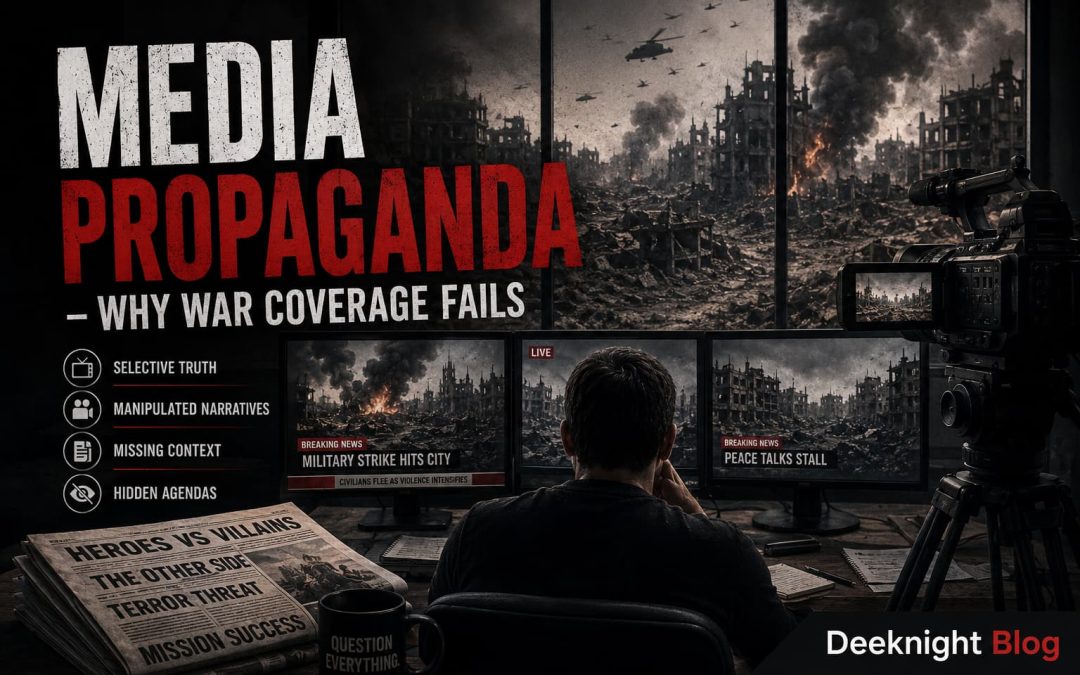
You turn on the news. A war is raging somewhere. The reporter sounds confident. But something feels missing. You don’t get the full picture. Instead you hear the same phrases again and again. “Freedom fighters” on one side. “Terrorists” on the other hand. This is not accidental. The media often fails to explain global conflicts honestly because it operates under deep structural pressures. Understanding media propaganda is the first step to seeing through the fog.
The Hidden Hand of Media Bias in War
Every conflict brings a flood of headlines. But have you noticed how war propaganda explained rarely reaches the audience? Journalists rely on official sources. Governments and militaries become the primary informants. Dissenting voices are pushed aside. This creates mainstream media bias that favors one narrative. For example when two countries fight the same action — bombing a city — gets called “precision strike” if done by a friendly nation but “indiscriminate attack” if done by an adversary. That is media bias in war at work.
These patterns are not new. But modern information warfare makes them faster and harder to catch. Social media amplifies media manipulation before fact‑checkers can react. By the time a correction arrives, the emotional damage is done. Public opinion has already hardened.
How Political Propaganda Shapes What You See
Political propaganda thrives during chaos. When people are scared, they cling to simple stories. Psychological warfare uses that fear to shape beliefs. A classic method is repetition. Hear something enough times from trusted news anchors and it becomes truth. That is why propaganda during war often relies on emotional triggers — images of suffering children, heroic soldiers and evil dictators. All real but selectively shown.
One side’s victims get front‑page coverage. Another side’s victims become a footnote. This is not a conspiracy. It is a system of western media bias that follows geopolitical interests. Countries allied with the West receive sympathetic reporting. Their adversaries are demonized. Nuance disappears.
News Manipulation and the Public’s Trust
News manipulation happens in small steps. A word change here. A missing context there. For example, “militants killed” versus “soldiers died”. Both can be true but they evoke completely different reactions. Over time public opinion manipulation trains audiences to cheer for one flag and boo another. Many people genuinely believe they are thinking for themselves. Yet they are following media narratives built by people far away.
Ask yourself: why does media and global conflicts coverage almost never show peace negotiations in detail? Why are diplomats boring, but explosions exciting? The answer is profit. Conflict sells. Drama gets clicks. Honest explanation — with all its grey zones — does not fit the business model.
Why the Media Lies About Wars (Not Always a Lie But a Distortion)
People often ask: why media lie about wars? The truth is more subtle. Rarely does a journalist wake up and decide to deceive. Instead, the lie comes from omission. How propaganda shapes public opinion works best when you believe you are getting both sides. But you are not.
Take any recent international conflict. Watch coverage from three different countries. You will see three different wars. One side’s defensive operation is another’s invasion. One channel shows flag draped coffins; another channel shows destroyed schools. Both are real. Both are incomplete. That is how the media influences society — not by inventing facts but by choosing which facts you see.
To understand how media narratives about China are often distorted, read Befriending China. It offers a diplomatic counter‑perspective that mainstream outlets frequently ignore.
Media Coverage of Global Conflicts: A Pattern of Repetition
Media coverage of global conflicts follows a tired script. Phase one: shock and outrage. Phase two: rally around our side. Phase three: dehumanize the enemy. Phase four: forget the war when a new one starts. This pattern repeats because how governments influence the media is often quiet. Government officials give briefings that sound like news. Journalists who ask hard questions lose access. So they self‑censor.
The result is media bias during international conflicts becomes invisible to the casual viewer. You only notice bias when you watch a channel that supports the other side. That moment of confusion — how can they report this so differently? — is your clue. That confusion is healthy.
Why News Coverage Feels One‑Sided
Why news coverage feels one sided has a simple answer: most media outlets are owned by corporations or states with their own interests. How fear is used in the media is a well‑studied tactic. Fear narrows attention. A fearful viewer does not question sources. They just want reassurance. So the media gives them a bad guy and a good guy. Comforting but rarely honest.
Media narratives during war are built like movie scripts. There is a hero, a villain and a ticking clock. Real war has no such clarity. Civilians suffer on all sides. Soldiers are often young and scared. Diplomats work behind closed doors. None of that fits a three‑minute news segment.
If you want to see how historical activism and media narratives have clashed for decades, pick up My Whirlwind Lives. It shows that today’s distortions are nothing new — just repackaged.
Information Control in Modern Media
Information control in modern media has become sophisticated. Leaks, anonymous sources and selective footage are tools. Media framing in global conflicts decides whether a protest is a “riot” or a “rebellion”. One word changes everything. The role of propaganda in war is not just about lies. It is about repetition of a convenient truth while ignoring inconvenient truths.
Media influence on democracy is huge. If voters cannot access honest conflict reporting, they cannot hold leaders accountable. A democratic decision requires real information. Propaganda replaces information with identity. You stop thinking about policy. You start rooting for a team.
Fear is the media’s favorite weapon. To learn how to break free from fear‑driven narratives and find A Realistic Path to Peace read. It directly addresses how fear blocks honest dialogue about conflict resolution.
Modern Propaganda Techniques to Watch For
Modern propaganda techniques include astroturfing (fake grassroots campaigns) bot networks and deep fakes. But the oldest technique is still the strongest: control the narrative. Media and political power are linked because politicians need media to win elections and the media needs politicians for exclusive stories. That marriage of convenience leaves the public as the last priority.
Connections for Deeper Understanding
To understand why honest conflict reporting is rare explore these related topics:
- Imperialism in the Twenty‑First Century – how old power structures shape today’s headlines.
- The Actual History of the US‑China Relations War Co‑operation and a Way Forward – a case study in media distortion.
- Are We Heading Toward World War 3 in 2026? – examines how media fear sells the next conflict.
These topics help you connect media propaganda to real‑world consequences. The more you learn the harder it becomes to swallow one‑sided reporting.
A Final Word and Your Call to Action
The media will not change on its own. But you can change how you consume it. Pause before sharing outrage. Ask: who benefits from this narrative? What is not being shown? Read books that challenge your views.
Start today. Head over to the Deeknight blog and explore the book sections that challenge mainstream media narratives. Pick any one of the recommended reads — just one chapter. Notice how a different perspective shifts your understanding of a current news story. Then share this blog with one friend who still trusts everything they see on TV. Let’s build a community of critical viewers one small step at a time.
Honest explanations of global conflicts are possible. But you have to work for it. The media will not hand it to you. That is the uncomfortable truth. Once you see it, you cannot unsee it. And that is a good thing.
FAQs
Q: Why does media coverage of wars feel one-sided?
A: Because most outlets rely on government sources and follow geopolitical interests creating a deliberate narrative rather than balanced reporting.
Q: How does propaganda influence public opinion during conflicts?
A: It repeats emotional triggers and selectively shows facts slowly shaping what people believe without them realizing it.
Q: What is the difference between media bias and media manipulation?
A: Bias is a subtle slant in reporting, while manipulation involves active tactics like omission framing or fake grassroots campaigns.
Q: Can I trust mainstream news to explain global conflicts honestly?
A: Not fully — mainstream news often prioritizes profit and power so you should cross-check sources and seek alternative perspectives.
Q: How can I stop falling for war propaganda?
A: Pause before sharing, ask who benefits from the narrative and read platforms like Deeknight blog for deeper unbiased analysis.