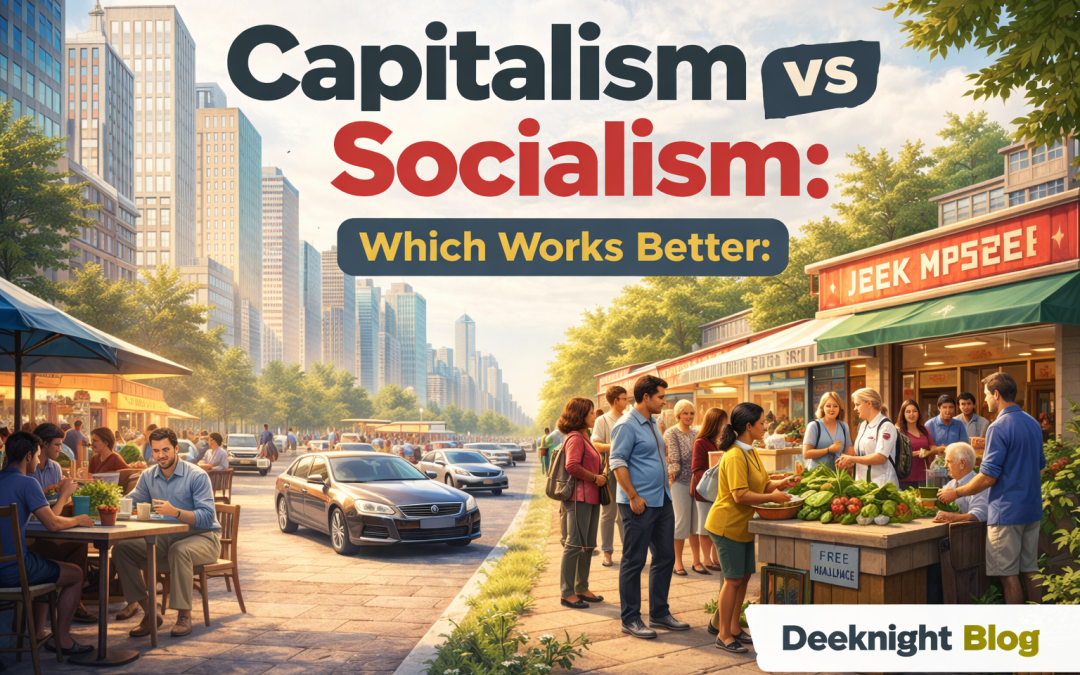
One of the most significant debates in contemporary economics and politics is the debate between capitalism and socialism. All countries, whether global superpowers or developing countries, are somewhere within these two systems. People are not only asking a theoretical but also a practical question today: which is better: capitalism or socialism?.
To provide this correctly, we must go beyond superficial comparisons and come to know the way both systems would work in actual life. Since the fact is that, no nation in the modern world is either a pure capitalist or a pure socialist.
What Capitalism and How Does It Work?
Capitalism is a type of economic system that is founded on the principles of privatization, free markets and profit making. In a capitalistic system, decisions regarding production, pricing and investment are made by individuals and businesses. The concept is easy to understand: competition brings about innovation and innovation brings about economic growth.
Theoretically, capitalism is a reward to hard work and creativity. Individuals are free to pursue business and invest and accumulate wealth. This is the reason why capitalist economies tend to develop more rapidly and generate technological progress.
Nevertheless, capitalism has its negative aspects. With time, wealth is likely to be concentrated in the hands of a few which results in inequality. Basic services such as healthcare or education can be costly thus casting a question of fairness in the society.
What Is Socialism and What Is the Difference?
Socialism on the contrary is oriented to equality and common good. The government in this system is greatly involved in the regulation of resources and wealth distribution. Basic services such as health, education and transport are usually state owned or regulated.
Socialism aims at bridging the divide between the rich and poor. It tries to make sure that everyone can access the basic needs, irrespective of his or her income level.
However, there are threats to socialism. The government may diminish competition and slack innovation when it exerts too much control. In other situations, it may also result in inefficiency and demotivation of employees.
Capitalism and Socialism: What is the Real Difference?
Trying to compare and contrast communism and capitalism, people tend to consider them as the extremes. Although the differences are evident, the truth of the matter is not so straightforward.
Capitalism focuses on the person and the freedom of the market whereas socialism focuses on the equality of the society and the role of government. One is opportunity oriented and the other is security oriented. They both strive to enhance the living standards, but they do so in extremely different ways.
Capitalism and Socialism have similarities.
Despite their differences, there are important similarities of socialism and capitalism that are often ignored. The two systems are aimed at organising the economies and enhancing the lives of the people. Both are dependent on institutions, policies and governance in order to operate well.
And even when we talk about the similarities between capitalism and communism, it is apparent that no system is capable of functioning without some kind of organization, regulations, and a degree of authority. Practically, both systems develop and change according to real-life needs.
Is this a Socialist or Capitalist USA?
The most frequent question that people pose is: Is US socialist or capitalist? It is not as simple as that.
The US is mainly a capitalistic nation. It has an economy that is stimulated by private business, free markets and consumer choice. Yet, it comprises some aspects that can lead individuals to question, is America socialist?
Social Security, government education and state-provided medical care are just some examples of programs that even the U.S. implements the concepts of socialism. This mixture can also be referred to as a social capitalistic system or a mixed economy.
What Does a Social Capitalist System Like?
A social capitalist system combines the positive features of two systems. It enables markets to be free and at the same time makes people safe through social programs.
The government intervenes in such a system when needed- it provides safety nets, regulates industries and provides fair competition. Meanwhile, people are free to be innovative and financially develop.
It is this equilibrium that leads to the view of experts that mixed economies are the most viable solution in the current day.
Recommended Stories
If you want to explore how global power, economics and politics connect with these systems, these articles offer deeper insights:
- How Imperialism Shapes Modern Wars – Lessons from History and Literature
- Iran-US Hold Talks in Oman as Fears of War Hang Over the Region
- Global Power & Domestic Change: Modern Imperialism and the Rise of Social Movements in the U.S
- Are We Heading Toward World War 3 in 2026
Is Capitalism or Socialism Better?
The belief that socialism is better than capitalism often comes from real-world economic struggles. Rising costs of living, healthcare expenses and income inequality make people question whether capitalism truly benefits everyone.
Capitalism is the best system to generate wealth, promote innovation and entrepreneurship. It allows individuals to be free to achieve according to their endeavors. Nevertheless, it may also cause inequality and social imbalance.
Socialism, however, is concerned with equality and equality of resource access. It makes sure that the basic needs are met by all. Nevertheless, it can be ineffective and fail to grow economically in case it is mismanaged.
There is a presumption that socialism is superior to capitalism based on actual economic hardships. An increase in the cost of living, the cost of healthcare, and income inequality are causing people to doubt whether capitalism really works to the advantage of all people.
Socialism is a symbol of fairness and security to many. It offers a system in which nobody is left out. But history indicates that there can be some severe difficulties in entirely socialist systems, particularly in efficiency and innovation.
What Works in the Modern World?
Considering the current economies, one will find that neither of the systems is ideal on its own. A combination of the two is the most successful in most countries today.
They use capitalist growth and innovation and socialist policies to stabilize and achieve equality. This is a hybrid solution that enables economies to be competitive and at the same time safeguard citizens.
Final Thoughts
It is not a question of capitalism or socialism. It concerns the knowledge of how every system functions and how they could be enhanced.
Rather than posing a question about whether or not America is socialist or whether capitalism or socialism is more appropriate, a more effective question is how do we establish a system that is both opportunity and equality based.
Extreme capitalism or extreme socialism is not the best solution in the modern world, but rather a balanced combination of both. The one that is really working is a system that promotes growth and at the same time makes everybody out of it.
FAQs – Capitalism vs Socialism
Q: What is capitalism in simple words?
A: Capitalism is an economic system where individuals and private businesses own resources and make money through competition in the market. Profit and personal freedom are the main drivers of this system.
Q: What is socialism in simple words?
A: Socialism is a system where the government plays a major role in managing resources and services. The goal is to reduce inequality and provide basic needs like healthcare and education to everyone.
Q: Which is better: capitalism or socialism?
A: There is no single winner. Capitalism is better for innovation and economic growth, while socialism is better for equality and social support. Most countries use a mix of both systems.
Q: Is the USA socialist or capitalist?
A: The USA is mainly capitalist, but it also has some socialist elements like public education, social security, and government support programs.
Q: What is the main difference between capitalism and socialism?
A: The main difference is ownership. In capitalism, private individuals own businesses and resources, while in socialism, the government or society controls key resources for public welfare.