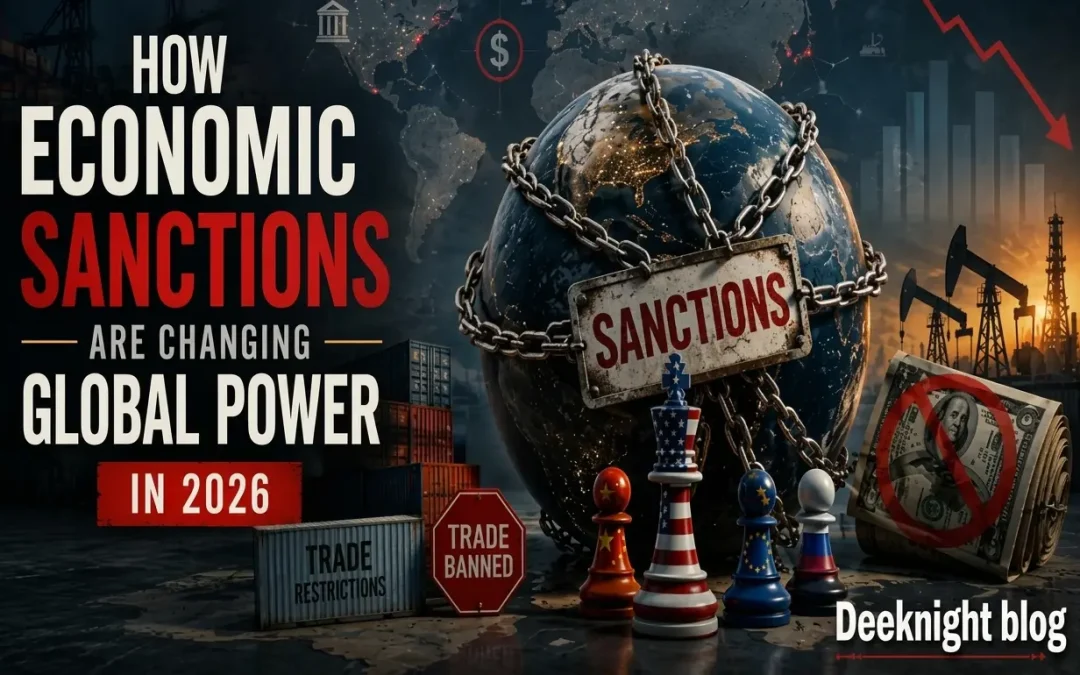
Economic sanctions have become a major tool of modern foreign policy. They let governments create pressure without sending troops into another country. Yet their effects can spread far beyond the original target. They can affect banks, energy markets, businesses, workers, and global trade.
In 2026, this issue has become even more important. The United States, China, Russia, and Iran are involved in wider struggles over security, trade, energy, and technology. These disputes show how money and markets can shape international power.
The bigger question is simple: can economic sanctions protect global security without creating a more divided world? The answer is not easy. Sanctions can change behavior in some cases. They can also push countries toward new partners and alternative financial systems.
What Are Economic Sanctions and How Do They Work?
Economic sanctions are restrictions used to pressure a country, company, group, or person. They can block money, limit trade, freeze assets, or control access to important goods. The United States uses sanctions for national security and foreign policy goals.
Sanctions can take many forms. Financial sanctions can block access to banks, while trade restrictions can limit imports or exports. Some measures also control advanced goods and technology. The basic aim is to raise the cost of certain actions without starting a direct war.
Why Are Economic Sanctions Becoming More Important in 2026?
Global markets are now tightly connected. A restriction in one country can affect companies and consumers thousands of miles away. This makes economic pressure a powerful tool. It can influence energy prices, investment decisions, shipping routes, and access to important goods.
The year 2026 shows how quickly this tool can expand. The United States continues to target Iranian networks, while the European Union has added new measures against Russia. The EU’s July 2026 package focused on energy, finance, crypto, trade, and Russia’s military industry.
How Sanctions Have Become a Tool of Economic Warfare
Modern economic warfare does not always involve bombs or battlefields. Governments can use banking systems, trade rules, technology controls, and financial networks to weaken an opponent. These tools can create pressure while keeping the conflict below the level of direct war.
However, economic warfare can have a long reach. A targeted country may find new buyers, suppliers, or payment channels. Over time, this can reshape international trade and encourage new economic partnerships. Sanctions can therefore change global power even when they fail to achieve their original political goal.
The United States and the Global Power of Sanctions
The United States has unusual influence because of its large economy and central role in global finance. The US dollar remains the leading reserve currency. Many international transactions also pass through systems connected to American financial markets.
This gives Washington strong leverage. Foreign banks and companies may avoid sanctioned entities because they fear losing access to the global financial system. That reach makes US sanctions powerful. Yet repeated use may also encourage other countries to build financial alternatives and rethink their US-China relations.
Are Sanctions Weakening the Power of the US Dollar?
Sanctions have encouraged some countries to explore ways to reduce their dependence on the dollar. This process is often called de-dollarization. Governments may use local currencies or alternative payment systems for some transactions.
Still, claims about a rapid collapse of the dollar are not supported by current data. The IMF reported that the dollar made up 57.13% of global official foreign-exchange reserves in the first quarter of 2026. The trend is worth watching, but dollar dominance remains strong.
| Financial trend | What it means |
| Dollar reserves remain dominant | The dollar still leads global reserves |
| Local-currency trade | Some countries want less dollar exposure |
| Alternative payment systems | Countries seek more financial options |
| Gold demand | Some central banks are diversifying reserves |
How Are Russia, Iran, and China Responding?
The experiences of Russia, Iran, and China show three different responses to economic pressure. Each country has different resources and trading relationships. Still, all three show why sanctions rarely operate in isolation.
Countries under pressure can search for new markets or strengthen regional partnerships. They can also build domestic industries and alternative payment routes. These responses can weaken the reach of sanctions over time.
Russia and the Search for Alternative Markets
Russia has faced extensive Western sanctions since its invasion of Ukraine. The measures target finance, energy, trade, and technology. The European Union adopted its 21st sanctions package in July 2026, adding further restrictions on Russian energy, financial services, crypto, and military-linked activity.
Russia has responded by seeking alternative markets and trading partners. Its oil exports remain especially important. The result is a more complicated global energy market where sanctions can change trade routes without completely removing Russian resources from world commerce.
Iran and Decades of Economic Pressure
Iran has faced sanctions for decades. Restrictions have targeted banking, energy, shipping, and military procurement. In 2026, US sanctions continued to focus on networks supporting Iranian weapons programs and oil operations.
Iran has also developed ways to keep trading through alternative networks. Its long history of US-Iran tensions also shows why economic pressure and diplomacy often become closely connected. Sanctions can hurt an economy deeply. They do not automatically produce political change, especially when leaders believe they can survive the pressure.
China and the Challenge to Western Economic Power
China presents a different challenge because of its huge role in manufacturing and global trade. It also holds an important position in many global supply chains. This makes economic competition between Washington and Beijing more complicated.
The rivalry now reaches beyond tariffs. It includes semiconductors, advanced technology, investment, energy, and critical resources. As this competition grows, other countries may face pressure to choose between competing economic systems.
How Sanctions Affect Ordinary People
Sanctions are usually announced as government policy. Ordinary people experience them through prices, jobs, banking problems, and shortages. Businesses may also struggle to obtain imported equipment or raw materials. These effects can become serious when restrictions remain for years.
The humanitarian question is therefore important. Targeted sanctions can focus on leaders or specific organizations. Broad measures can reach much further. Policymakers must consider whether the pressure they create is worth the civilian cost.
Do Economic Sanctions Actually Work?
The effectiveness of sanctions depends on what they are supposed to achieve. Economic damage alone does not prove success. A country may suffer serious losses while refusing to change its main policies.
A useful way to judge sanctions is to ask three questions. Was the political goal clear? Did major countries cooperate? Could the target find alternative markets? These factors often decide whether pressure leads to negotiation or resistance.
When Sanctions Fail and Create New Problems
Sanctions can produce unexpected results. A country that loses one market may find another. A company that cannot use one supplier may search for a replacement. Financial restrictions can also encourage new payment routes and informal trading networks.
These changes can make sanctions harder to enforce. They can also deepen geopolitical tensions. When countries feel permanently excluded from Western markets, they may invest more heavily in alternative economic relationships.
Economic Sanctions, Imperialism, and the Struggle for Global Power
Economic power has shaped international politics for centuries. Today, economic power can come through finance, trade, technology, resources, and market access. A powerful state can sometimes influence another country without using military force.
This raises difficult questions about international relations and modern imperialism. Economic dependence does not always mean imperialism. Yet heavy dependence on one powerful partner can limit a country’s choices and create a lasting imbalance.
Are Sanctions Creating a More Divided World?
The global economy once seemed to be moving toward deeper integration. That trend has become less certain. Countries now care more about secure supply chains, domestic production, and strategic trade relationships.
This shift could create a more fragmented world. Instead of one highly connected system, several regional networks may grow stronger. Such a system could give countries more choices. It could also make trade more expensive and cooperation harder.
The New Cold War and Economic Competition
The term New Cold War often describes the growing rivalry between the United States and China. The comparison is not perfect. Today’s economies remain deeply connected. Still, the competition now covers trade, technology, finance, and security.
This makes economic tools more important. Restrictions on advanced technology can affect future industries. Limits on investment can shape business decisions. Competition over critical resources can influence energy and manufacturing for years.
Can Diplomacy Offer a Better Alternative to Sanctions?
Sanctions can create pressure. They cannot create trust on their own. That is why diplomacy remains important when governments want lasting solutions to major disputes.
Sanctions can work better when they support negotiations. Recent peace proposals also show how diplomacy can create another path when economic pressure alone fails. Clear conditions for sanctions relief can give a targeted country a reason to change course.
What Could a More Peaceful Sanctions Policy Look Like?
A stronger sanctions policy should have a clear political goal. It should also protect humanitarian needs and explain what actions could lead to sanctions being removed. This gives pressure a purpose instead of making it an open-ended punishment.
Targeted measures can also reduce unnecessary harm. Regular reviews can show whether sanctions are working. Most importantly, sanctions should support negotiation when negotiation remains possible. Pressure and diplomacy do not have to be opposites.
The Future of Economic Sanctions in a Changing World
Sanctions are likely to remain important as global competition grows. Financial restrictions may become more precise. Technology controls may also expand as advanced computing, chips, and strategic industries become security issues.
At the same time, countries will keep searching for alternatives. New payment systems, regional trade networks, and domestic industries could reduce the reach of Western restrictions. This may create several centers of economic power instead of one dominant system.
Can Economic Pressure Lead to Peace?
Economic pressure can sometimes push governments toward negotiation. It can also make dangerous actions more costly. Yet pressure alone rarely solves the deeper causes of conflict. Lasting peace needs political agreements and credible diplomacy.
The future of sanctions will therefore depend on how wisely countries use them. If they support negotiation, they may help prevent wider conflict. If they become permanent tools of rivalry, they could deepen global division. The real challenge is finding a real path to peace while managing a changing balance of power.
Frequently Asked Questions (FAQs)
Q1: Which countries are currently facing economic sanctions?
Answer: Countries facing major sanctions include Russia, Iran, North Korea, Syria, Venezuela, Belarus, and Cuba, although the restrictions differ by country and sanctioning government.
Q2: Are sanctions really hurting Russia?
Answer: Yes. Sanctions have increased Russia’s economic and financial costs, especially in energy, technology, and finance. However, Russia has adapted through alternative markets and trade partners.
Q3: Which country has the most sanctions in the world?
Answer: Russia is widely regarded as the world’s most sanctioned country, with thousands of restrictions imposed by the United States, EU, and other governments.
Q4: How effective are economic sanctions?
Answer: Sanctions can cause serious economic damage, but their political success varies. They work best when the goals are clear, enforcement is strong, and major countries cooperate.
Q5: How much money has Iran lost from sanctions?
Answer: There is no single reliable figure for Iran’s total losses from decades of sanctions. The cost includes lost oil revenue, reduced trade, lower investment, and wider economic damage.