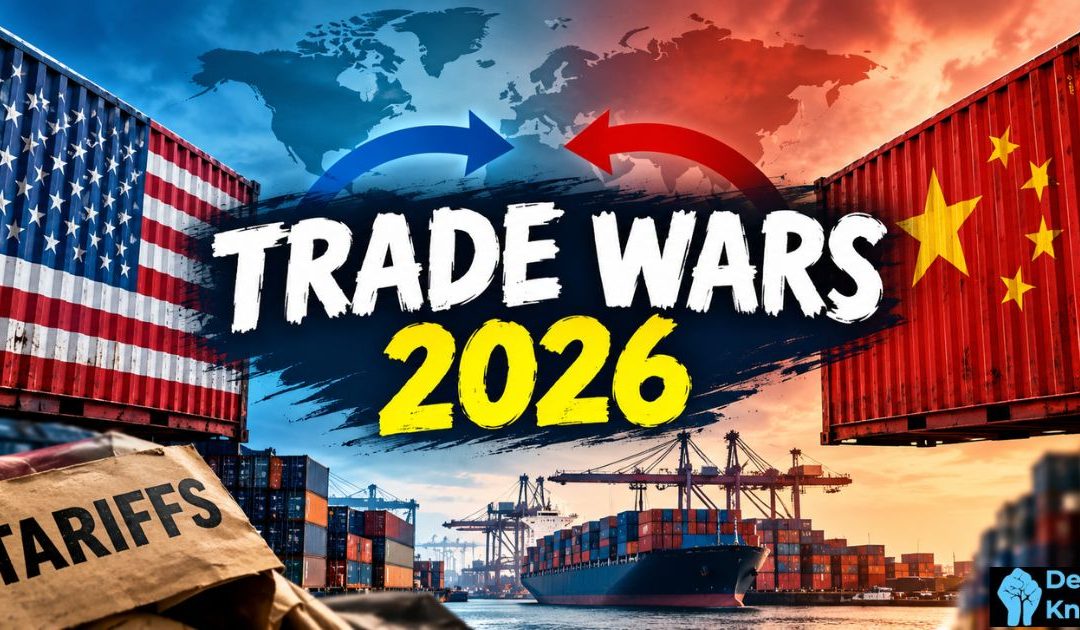
Trade Wars 2026 are changing how countries compete for money, markets, technology, and influence. What once looked like a simple fight over tariffs has become part of wider global trade tensions.
The United States and China remain at the center of this shift, but the effects reach far beyond them. Rising tariffs can reshape global supply chains, increase costs, and push businesses to find new suppliers. At the same time, governments are using trade rules to protect industries they see as vital to national security.
This growing geopolitical competition is also affecting developing countries and international markets. As trade becomes more political, the big question is simple: could today’s economic rivalry change global power for years to come?
What Is a Trade War?
A trade war happens when countries use trade restrictions against each other. A government may raise tariffs on imported goods, while its trading partner may respond with new tariffs or other restrictions. A wider conflict can also involve tariff policy, import limits, subsidies, investment controls, and export restrictions. These measures can create economic pressure without a military attack.
A normal trade dispute may focus on one product or rule. A trade war is usually broader and can affect several industries at once. It may also become part of a larger struggle over economic and strategic power. In today’s economy, trade policy can influence prices, factories, technology, jobs, and national security. That makes modern trade wars much bigger than simple arguments over import costs.
| Trade tool | Main purpose | Possible effect |
| Tariffs | Make imports more expensive | Higher prices |
| Trade barriers | Limit market access | Lower trade |
| Export controls | Restrict sensitive products | Technology delays |
| Subsidies | Support domestic industries | More competition |
| Investment restrictions | Limit foreign influence | Less capital flow |
| Economic sanctions | Create political pressure | Reduced access to markets |
The bigger point is that trade policy now affects much more than imports and exports. It can shape jobs, technology, investment, national security, and even a country’s position in the global economy.
Why Are Trade Wars Growing Again in 2026?
In 2026, governments are treating trade as a strategic issue rather than a simple economic matter. They want more domestic manufacturing and greater control over products that are vital to their economies. Semiconductors, batteries, energy equipment, minerals, and artificial intelligence technology have all become important parts of national security and economic planning.
The WTO says geopolitical tensions, government intervention, technology rivalry, and economic security concerns are putting greater pressure on the global trading system. Countries are therefore trying to build more resilient global supply chains instead of depending too heavily on one supplier. Businesses are responding by changing suppliers, moving production, and keeping larger stocks to reduce future risks.
These changes show why Trade Wars 2026 are affecting business decisions far beyond tariffs alone.
The U.S.–China Trade War Is About More Than Tariffs
The U.S.–China trade war shows why modern trade conflicts are so complicated. In 2026, the rivalry goes far beyond tariffs on imported goods. The United States and China are competing over semiconductors, artificial intelligence, manufacturing, rare earth materials, and strategic supply chains. Each side wants to protect important industries while reducing its dependence on the other.
The Council on Foreign Relations notes that tariffs, Chinese rare earth restrictions, and technology export controls remain major points of tension between the two countries.
China also plays a huge role in manufacturing and global trade. That makes complete economic separation extremely difficult. The issue is not simply whether American companies buy Chinese products. It is about who controls important technologies, materials, factories, and production networks.
The technology side of this rivalry is becoming just as important as tariffs. Dee Knight explores this issue in Can the U.S. and China Avoid a Tech-Driven Cold War? which examines AI chips, export controls, and the future of U.S.–China competition.
To understand why this competition matters globally, see Why Is China So Important to the World? and Dee Knight’s analysis of U.S.–China Relations 2026.
This is where trade meets technology competition. A country that controls advanced chips, batteries, software, minerals, or manufacturing capacity can gain influence far beyond its own borders.
How Tariffs Can Change Supply Chains
Tariffs can change where companies produce goods. When importing from one country becomes more expensive, businesses may search for another supplier. That does not mean factories move overnight. Companies must consider workers, infrastructure, shipping costs, energy prices, taxes, and access to raw materials. Moving a complex factory can take years. Still, the direction is clear. Companies increasingly want diversified supply chains.
UNCTAD reports that geopolitical tensions and industrial policies are pushing firms to diversify suppliers and move production closer to major markets. These changes show how Trade Wars 2026 are reshaping where companies manufacture, source materials, and build new supply networks.
This can create opportunities for countries such as Mexico, India, Vietnam, and others that can attract new investment. At the same time, supply chain disruption can raise costs for companies and consumers. The bigger change is strategic. A factory is no longer viewed only as a place where products are made. It can also be part of a country’s national security strategy.
Are Trade Wars Becoming Economic Warfare?
Trade wars can increasingly resemble economic warfare because governments can use economic tools to pressure rivals without direct military action.
Tariffs can raise costs. Export controls can restrict access to advanced technology. Financial restrictions can make international business harder. Economic sanctions can also limit a country’s access to markets, finance, and important goods.
Dee Knight’s article on How Economic Sanctions Are Changing Global Power in 2026 explains how these tools are becoming part of the wider struggle over international influence.
The danger appears when economic pressure becomes permanent. Companies may stop investing in rival markets. Countries may build separate technology systems. Trust between trading partners can weaken.
That creates trade fragmentation. Instead of one connected market, the world could develop competing economic networks.
How Trade Wars Affect Developing Countries
Developing countries often have less power during major trade disputes. They may depend heavily on exports, imported energy, machinery, food, or industrial materials.
When tariffs rise, exporters can lose access to major markets. When shipping routes become unstable, transport costs can increase. When investment becomes uncertain, companies may delay new factories.
UNCTAD warns that smaller and less diversified economies are especially exposed to trade volatility and supply-chain changes.
Yet there can also be opportunities. Companies looking for alternatives to China or other major suppliers may invest in developing economies. New factories can create jobs and strengthen local industries. Countries such as India, Vietnam, Mexico, and Indonesia may attract new production as companies look for alternative suppliers and more diversified supply chains.
The outcome depends on infrastructure, skills, political stability, and access to international markets. Countries that can offer reliable business conditions may benefit from the reshaping of global production.
Can Trade Wars Create a Divided World?
The biggest long-term risk is not one tariff. It is a world divided into competing economic blocs.
Countries may increasingly trade with political partners instead of choosing suppliers based only on cost. Technology standards could split into separate systems. Companies could build duplicate factories to serve different markets.
That process is known as trade fragmentation. It can make countries feel safer in the short term, but it may reduce efficiency and increase costs over time.
The WTO has highlighted this tension. Its 2026 research suggests that stronger multilateral cooperation could raise global GDP by 2.9%, while a geopolitically fragmented trading system could reduce it by 5.1%.
This matters because trade is more than buying and selling. It connects people, companies, workers, and governments. When those connections weaken, opportunities for international cooperation can weaken too.
Trade Wars, Imperialism, and Global Power
Trade has always been connected to power. During the age of empire, powerful states often used military force, colonial control, and commercial influence to dominate weaker regions.
Modern geopolitical competition looks different. Countries rarely need formal colonies to gain economic influence. Access to markets, technology, finance, resources, infrastructure, and supply chains can provide enormous leverage.
That does not mean every tariff is imperialism. The comparison must be made carefully. Modern states also use trade rules to protect workers, support industries, and reduce strategic risks.
Still, economic dependence can create political influence. A country that controls a critical resource or major manufacturing network may have bargaining power when another country needs that resource.
Dee Knight’s discussion of Imperialism in the Twenty-First Century explores how modern power can operate through financial systems, technology, trade, and supply networks.
This is why global power is no longer measured only by armies. Economic strength can shape diplomatic choices just as strongly.
Can Trade Wars Be Stopped?
Trade wars do not have to continue forever. Countries can negotiate tariffs, create trade agreements, settle disputes, and establish clearer rules for sensitive industries.
The bigger challenge is trust. Governments may accept temporary restrictions while they negotiate. Permanent restrictions can create deeper divisions.
The WTO’s rules were designed to make international trade more predictable and reduce the risk of damaging trade conflicts. Its 2026 report argues that rules-based cooperation remains important even as the world becomes more multipolar and competitive.
This does not mean countries should ignore legitimate security concerns. It means governments need clear limits and better communication. National security should not become a reason for every trade restriction.
The same lesson applies to military conflicts. Economic pressure can sometimes prevent escalation, but prolonged rivalry can also increase mistrust. The experience of the Iran conflict shows why regional tensions can quickly create wider economic and security risks. For context, see Can the Iran War Trigger a Wider Middle East Conflict in 2026?.
What Trade Wars Could Mean for Global Peace
Trade does not automatically create peace. However, strong economic relationships can make conflict more costly. Countries that depend on each other have more reasons to keep communication open.
The problem begins when trade becomes another battlefield. If every economic relationship is viewed through national security, cooperation becomes harder.
The WTO has highlighted this tension. Its 2026 research suggests that stronger multilateral cooperation could raise global GDP by 2.9%, while a geopolitically fragmented trading system could reduce it by 5.1%.
The future of international trade will therefore depend on balance. Countries need resilient supply chains without destroying global connections. They need strategic independence without creating permanent economic walls.
That balance could determine whether Trade Wars 2026 become a temporary period of adjustment or the beginning of a much more divided global economy.
Conclusion
Trade Wars 2026 are changing global power far beyond tariffs. Technology restrictions, supply-chain policies, sanctions, and competition over strategic industries now shape how countries protect their interests and influence.
The U.S.–China trade war shows how closely trade and geopolitics are connected. Developing countries may gain new investment, but deeper trade fragmentation could also raise costs and weaken international cooperation. The challenge is finding a balance between economic security and open trade.
Trade competition does not have to become permanent confrontation. Countries can protect vital industries while keeping channels for cooperation open. For more discussion on war, peace, global power, and current events, explore Dee Knight’s Blog. A more cooperative global economy can help create the stability needed for lasting global peace.