
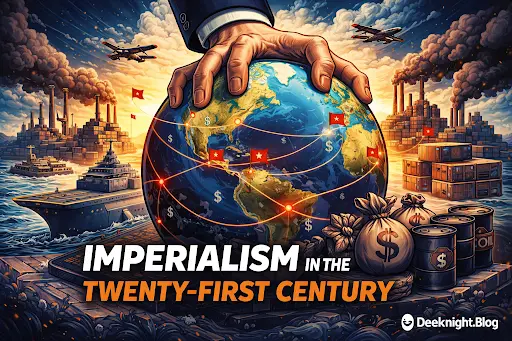
Imperialism still exists in the twenty-first century. It is not just a thing of the past. The world powers have preserved their fundamental bases, even though the era of free colonial expansion is, in many ways, over.
Having developed in the 21st century, imperialism has taken a new form. It is no longer dependent on planting flags. Rather, it functions via monetary frameworks, online infrastructure and supply lines.
Imperialism in the twenty-first century cannot be understood without going beyond old maps. It involves a study of the flow of wealth and power in the contemporary globalized economy.
What is Imperialism? (Definition and Context)
To comprehend the present state of affairs, we need to begin with a vague definition of imperialism. Imperialism is simply the expansion of control of powerful entities or nations on other entities or nations.
Nowadays, this power is not often related to physical occupation. Modern imperialism is the act of economic, political, and military coercion to dominate the resources and policies of independent states. It is a process that keeps the world in a pecking order.
Why is Imperialism Important Today?
Many wonder: Why is imperialism important in a post-colonial world? The answer lies in global inequality. Imperialism explains why certain nations remain trapped in debt while others accumulate vast wealth. It is the invisible force shaping trade agreements, labor laws, and even environmental policies across the globe.
The Economic Motives for Imperialism in the 21st Century
The engine of imperialism today is profit. The economic motives for imperialism have shifted from direct land ownership to the control of global markets.
1. Labor Arbitrage
Large corporations from wealthy nations seek “cheap labor” in the Global South. By moving production to countries with low wages and few labor protections, they maximize profits. This creates a “race to the bottom” for workers globally.
2. Resource Extraction
The move to green energy has led to another scramble of minerals. One of the primary examples of economic imperialism is the urge to obtain raw materials, the case of lithium in South America and that of cobalt in Africa.
3. Financial Hegemony
Wealthy nations use international financial institutions to dictate the internal policies of developing countries. High-interest loans and “structural adjustments” often force poorer nations to privatize their public services, benefiting foreign investors.
Examples of Modern Day Imperialism.
To see modern day imperialism in action, we must look at how power is projected through technology and finance.
- Debt-Trap Diplomacy: Countries are being saddled with unpayable debt. Unable to pay, they are coerced to surrender to foreign nations strategic resources such as ports or mines.
- Tech Imperialism: The information, hardware and software of billions of people is in the hands of a small number of global tech giants. This enables them to affect culture, politics and business at a global level.
- Monetary Control: When a single currency is predominant in international trade. There is the ability of one country to impose sanctions on another country that can cripple the economy of the targeted country without shooting a bullet.
Global Stability, Militarism and War.
War is directly related to imperialism. In order to safeguard the economic interests, the mighty nations keep a huge military force all over the world.
Imperialism and militarism are cooperative. Bases are commonly set up strategically close to a trade route or source of energy. The failure of economic pressure in turn leads to the intervention or change of regime so that a nation can be left open to outside capital.
A characteristic of the 21st century is these imperialist wars presented as humanitarian work and the achievement of geopolitical control.
Recommended Stories
If you want to explore the personal, historical and strategic sides of these global shifts, we recommend these essential reads:
- How Imperialism Shapes Modern Wars – Lessons from History and Literature: A deep dive into how past conflicts inform today’s geopolitical strategies.
- Global Power & Domestic Change – Modern Imperialism and the Rise of Social Movements in the U.S: Understanding how foreign policy impacts internal social struggles.
- A Realistic Path to Peace – Rethinking War, Power and Global Responsibility: A framework for moving away from imperialist conflict toward sustainable global cooperation. Buy book now: [A Realistic Path to Peace]
- Befriending China – A Complete Guide to People-to-People Peacemaking, Travel, Culture and Modern Achievements: An exploration of diplomacy and culture as a counter-narrative to modern “Cold War” mentalities. Buy book now: [Befriending China]
- My Whirlwind Lives – Lessons from Decades of Activism and Resistance: Personal accounts from the frontlines of social and anti-war movements. Buy book now: [My Whirlwind Lives]
The Enduring Effect of Imperialism.
The most vulnerable populations in the world experience the effects of imperialism.
- Economic Stagnation: Due to the constant transfer of wealth to foreign countries many countries are always left in the developing stage.
- Loss of Sovereignty: Governments are disempowered to make decisions that serve their own against foreign corporations.
- Environmental Degradation: Imperialist activities usually result in exploitation of natural resources with minimal concern of local ecosystems.
Imperialism has resulted in a world with people who make the rules and people who have to obey the rules.
Summary: The Future of Sovereignty.
The modern world is more advanced when it comes to imperialism. It is interwoven into the framework of our world economy. These power relations are, however, being tested as the world is shifting towards a multipolar system.
The key to a more equal global community is starting to understand these structures. We can start supporting the world in which sovereignty and human rights will have priority over corporate profit by understanding the examples of modern imperialism.
Frequently Asked Questions
Q: How is old and modern imperialism different?
A: In the traditional imperialism, the dominant force was physical colonization and an actual conquest, but in modern imperialism, economical pressure, debt-trap diplomacy, and control via the Internet are the tools of influence.
Q: What role do economic interests play in the imperialism of the twenty-first century?
A: Powerful countries are interested in labor arbitrage, the possession of rare natural resources such as lithium, and the growth of financial monopolies to sustain the unequal world wealth distribution.
Q: How is modern imperialism related to militarism?
A: Militarism is the coercion of imperial might, seizing trade routes and other areas of resource wealth by means of intervention or standing army bases.
Q: What is an example of imperialism today?
A: One major one is the so-called debt-trap diplomacy, under which unsustainable debt traps compel developing countries to give away strategic assets such as ports or mines to foreign investors.
Q: What are the consequences of imperialism on the sovereignty of smaller countries?
A: It restricts the independent policy decisions that a country can make and in many cases it compels governments to act in the interests of their foreign corporations rather than serving the interests of their own people.


