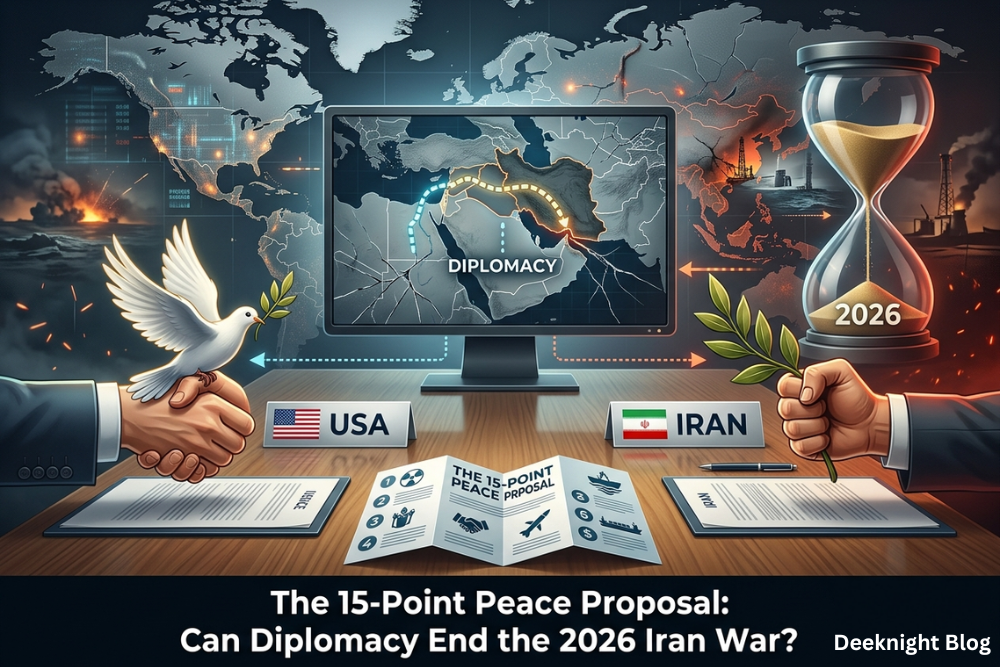
The world is at a crossroad. By the end of March 2026, the physical confrontation between the United States and its regional allies and the Islamic Republic of Iran had moved away from a localized series of skirmishes to a full-scale regional crisis. As the world energy markets are crashing and nuclear buildup is a possibility, a 15 point peace proposal. Which has been brokered by neutral mediators, has leaked out.
Is it a true diplomatic off-ramp or is it an elevated tool of modern imperialism that aims at bringing a sovereign nation to its knees? We need to unravel the 15 points not only as a policy, but also as a roadmap in the future of world stability.
The Anatomy of the 2026 Crisis
It is imperative to note that the Maximum Pressure tactics failed before venturing into the 15 points. The 2026 war that was the result of maritime conflicts and intelligence failures has demonstrated that military power alone cannot set the rules in the multipolar world. The present proposal is a cry in desperation by the world powers to avoid a complete economic meltdown.
The Peace Movement Its Roles.
As activists, we understand that peace is the term that is frequently applied as the mask to tactical pauses. The peace that is described in the book A Realistic Path to Peace by the author and activist Dee Knight is not just the lack of war, but the availability of justice and the cessation of imperialist aggression. It is this 15-point plan that has to be questioned through the same prism.
Recommended Stories
Explore More on Peace Diplomacy and Global Conflicts
The 15 Points of the 2026 Peace Framework
Here are the core pillars of the proposed agreement: “reported / media leaks”.
- Immediate Bilateral Ceasefire
- Unrestricted Access to the Strait of Hormuz
- Permanent Nuclear Enrichment Halt
- Repatriation of Existing Uranium Stockpiles
- Decommissioning of Underground Strategic Facilities
- Long-Range Ballistic Missile Production Caps
- Termination of Regional Proxy Funding and Support
- “Anytime, Anywhere” IAEA Inspections
- Multilateral Regional Maritime Security Pact
- Phased and Verified Sanctions Relief
- Technical Civilian Nuclear Assistance
- Tri-Nation Energy and Power Grid Consortium
- Comprehensive Exchange of Prisoners and Detainees
- Iranian Economic Reconstruction and Stabilization Fund
- Legally Binding Mutual Non-Aggression Treaty
In-Depth Analysis: Decoding the 15-Point Diplomatic Strategy
Before considering how weighty this proposal is we should not put it down to the bullet points alone but examine the weighty geopolitical implications of each demand. In this section, I will delve deeper into the technical and strategic nuances of the 2026 peace initiatives.
1. Ceasefire between the two sides.
The initial and the most important measure is a complete stop of hostilities. These involve air attacks, drone attacks, and cyber-war attacks. To ensure this is successful, a neutral oversight agency, such as a combined task force of the non-aligned countries, needs to ensure that both Operation Epic Fury and Iranian counter attacks have ceased.
2. Free passage to Strait of Hormuz.
The main reason of western involvement is energy security. The second point requires that Iran should lift all naval blockades and mines in the Strait. On their part, the U.S. has to give assurances that commercial vessels will not be used in intelligence collection or in carrying troops.
3. Permanent Nuclear Enrichment Halt.
The proposal requires Iran to stop any further uranium enrichment past the level of 3.67. Although this reflects the past agreements, the 2026 version will have no-fail conditions where military retaliation can occur immediately in case the levels of enrichment soar, something that Iranian negotiators have vehemently objected to.
4. Repatriation of Existing Uranium Stockpiles
Uranium enriched to 20 percent or 60 percent will be transported to a neutral third party country like Kazakhstan or Oman. This is bound to increase Iranian break out time to more than one year effectively eliminating the possibility of a nuclear armed state in the short term.
5. Shutting down of Strategic Facilities.
The suggestion is aimed at decommissioning part of the Fordow and Natanz plants. The west contends that these underground facilities are like fortress labs whereas Iran considers them to be important sovereign facilities to enhance scientific developments.
6. Production Caps on Long-range Missiles.
The sixth point changes the guideline towards conventional and not nuclear. It requires the prohibition of missiles that have a range of more than 2,000 km. This has a direct effect on the capacity of Iran to exert power in the Mediterranean but exposes it to other regional powers that have better air forces.
7. Dismissal of Regional Proxy Support.
One of the main targets is the “Axis of Resistance. The plan requires the termination of support and armament of Hezbollah in Lebanon, Houthis in Yemen, and other militia in Iraq. According to critics, this fact overlooks the organic, localized character of these movements.
8. Anytime, Anywhere” IAEA Inspections.
The International Atomic Energy Agency (IAEA) would get unparalleled access. This encompasses military bases and university research institutions privately, pressure that has all historically been one of the red lines of the Iranian leadership.
9. The Regional Maritime Security Pact.
As an alternative to a Western-dominated naval presence, point nine proposes a collective security system comprising Iran, Saudi Arabia, UAE and Qatar. This is in an attempt to indigenize security but the U.S would still stick around as a silent partner.
10. Phased Sanctions Relief
This is a Compliance-for-Cash model, as compared to past deals which were all-or-nothing. A particular set of secondary sanctions on oil and banking will be removed, in the case of each of the verifiable decommissioning steps.
11. Nuclear Cooperation with Civilians.
To demonstrate that it is not an anti-science crusade, the West provides technical support in the production of medical isotopes and in the production of civilian energy. This becomes the carrot to the stick of decommissioning of a facility.
12. The Tri-Nation Energy Consortium.
A radical suggestion to connect the Iranian, Iraqi and Saudi power networks. This renders the war prohibitively expensive to all the parties by making the regional economies interdependent.
13. Total Prisoner and Political Barter.
A humanitarian act to build trust. This involves the re-entry of dual nationals and those held on alleged security charges in the 20252026 protest waves.
14. The Economic Reconstruction Fund Iran.
A global fund which was to be administered by the IMF and Asian Infrastructure Investment Bank (AIIB) to inject liquidity into the Iranian Rial. This is in lieu of stabilizing the domestic front and minimising the internal urge to military adventurism.
15. The Mutual Non-Aggression Treaty.
The last one is a legally binding treaty that is formal. It guarantees that a signatory will not use its land to attack or contribute to the attack on another. This would entail the U.S dismantling some base in the region- an aspect that the Pentagon is now opposing.
The Geopolitical Context of 2026
We should consider the Semantic Entities in order to comprehend the reason for coming up with these 15 points now. The tendency towards the Multipolar World Order has undercut the usefulness of unilateral sanctions imposed by the West. The Diplomatic Shield, formed by the role that China can play as a mediator, and by the strategic partnership that Russia has with Iran, is something that the U.S. can no longer ignore.
To the question of why the 2026 Peace Plan fails or succeeds, the answer is in Point 15.
The Path Forward: A Realistic Peace
Is this 15-point plan a path to peace? History suggests that without addressing the Imperial Core, these treaties are merely pauses before the next storm. As peace activists, our job is to advocate for a solution that respects the self-determination of all nations.
We must move beyond the “war-as-policy” mindset. The current crisis is a symptom of a failing global architecture. If we want a world without the threat of a “2026 Iran War,” we must build a system based on mutual respect and shared prosperity, not coercive 15-point mandates.
FAQs
Q: How was the 15‑point peace proposal sent to Iran?
A: The U.S. sent it indirectly through Pakistan as a mediator, since Washington and Tehran are not holding direct talks.
Q: Has Iran accepted the proposal?
A: Iran has rejected or criticized the plan, calling it one‑sided and unacceptable so far.
Q: Are talks still happening despite the rejection?
A: Yes — back‑channel and mediator‑led contacts continue, with some diplomatic engagement still possible.
Q: Does the proposal actually pause fighting?
A: The U.S. has paused certain strikes to allow diplomacy more time, but fighting continues without a formal ceasefire.
Q: Could diplomacy ultimately end the war?
A: It might if both sides adjust terms and agree to talks — but current gaps remain wide and unresolved.