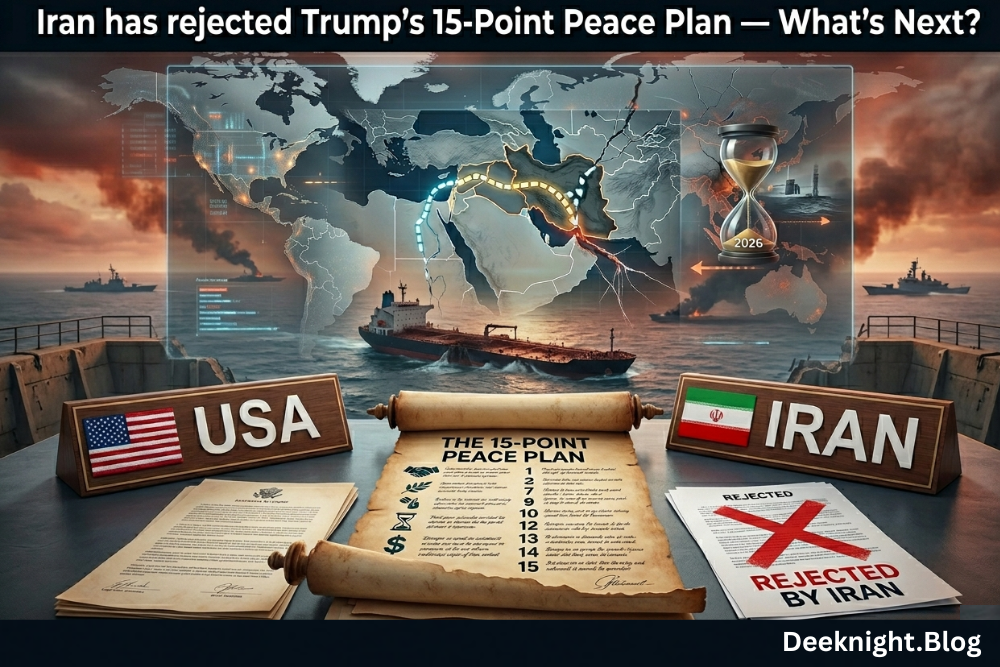
The Middle East has put the diplomatic air cold. The Iranian government officially sent the response to the 15-point proposal by the Trump administration on March 25, 2026. The verdict? A resounding rejection. Labeling the American terms as “maximalist,” “unreasonable” and “out of touch with the reality of the battlefield,” Tehran has made it clear that it will not negotiate under the shadow of “Operation Epic Fury.”
For the readers of deeknight.blog, this comes as no surprise. As we have documented, true peace cannot be dictated through the barrel of a gun. While Washington spins a narrative of “imminent deal-making,” the Iranian leadership has pivoted, offering its own set of baseline conditions that challenge the very core of Western interventionism.
The 5 Counter-Conditions of the Islamic Republic
In a formal statement released via Press TV and communicated through Pakistani intermediaries, Iran has laid out five non-negotiable points that must be addressed before any ceasefire can be finalized. Unlike the US proposal, these points focus on reparations, regional unity, and maritime sovereignty: “reported / media leaks”
- A Total Halt to Aggression and Assassinations
- Concrete Mechanisms and Legal Guarantees Against Resumption of War
- Full Payment of War Damages and Reparations
- International Recognition of Sovereignty over the Strait of Hormuz
- A Comprehensive Ceasefire for All Regional Allies and Proxies
Extreme Inquiry: Why Iran Uses a Strategic Rejection.
In an attempt to determine the reason why these five points have stagnated progress of the “Trump Peace.” We need to discuss the geopolitical and humanitarian stakes involved in each demand. This is not merely a denial, this is a counter-doctrine.
1. A Total Halt to Aggression and Assassinations
Iran is demanding a complete and immediate end to all forms of military aggression covert operations and targeted assassinations. This includes drone strikes, intelligence-led attacks and actions against key figures.
Tehran views these actions as violations of sovereignty and a major barrier to trust making their cessation essential for any peace process to move forward.
2. Concrete Mechanisms and Legal Guarantees Against Resumption of War
Iran insists that any agreement must include enforceable legally binding guarantees to prevent future conflict. Rather than relying on political promises Tehran wants structured mechanisms.
Potentially involving international oversight to ensure that neither side can easily return to hostilities once peace terms are agreed upon.
3. Full Payment of War Damages and Reparations
A central demand from Iran is financial compensation for the economic losses, infrastructure damage and human suffering caused by years of conflict and sanctions.
This is not only about recovery but also about holding the United States accountable although such a demand remains highly difficult to achieve in negotiations.
4. International Recognition of Sovereignty over the Strait of Hormuz
Iran is calling for clear international acknowledgment of its rights and authority over the Strait of Hormuz. As one of the most important global oil routes. This area holds major economic and strategic value.
By pushing for formal recognition Iran wants to secure its position and reduce the chances of outside interference or disputes over control in the future.
5. A Comprehensive Ceasefire for All Regional Allies and Proxies
Iran is calling for a broad ceasefire that extends beyond direct conflict with the United States to include all allied groups and regional proxies. This reflects the complex nature of Middle Eastern geopolitics.
Where multiple actors are involved and highlights Iran’s aim to reduce tensions across the entire region not just at a bilateral level.
Recommended Stories
To better understand the broader context behind Iran’s decision and what could happen next, you may find these related articles insightful:
- The 15-Point Peace Proposal: Can Diplomacy End the 2026 Iran War
A deeper look into the original proposal and whether it ever had a realistic chance of success. - Iran-US Hold Talks in Oman as Fears of War Hang Over the Region
Explores ongoing diplomatic efforts and the fragile nature of negotiations. - From the Strait of Hormuz to South Asia: How Global Conflicts Are Reshaping World Peace
Examines how regional tensions are influencing global stability and trade routes. - Is Peace Possible in the Middle East? A Realistic Path After the Gaza War
A broader perspective on peace prospects in one of the world’s most volatile regions. - How Imperialism Shapes Modern Wars – Lessons from History and Literature
Provides historical context to understand power dynamics behind modern conflicts.
The “What’s Next” Factor
As Iran is strongly denying the offered deal, the question of what is to be done next arises, and the answer is not that easy. There are diplomatic avenues that are still open and both parties are standing their ground on their demands and a quick solution would not be achieved.
More military pressure or renewed negotiations can be pursued by Donald Trump, whereas Iran is likely to keep enjoying regional power and position resources such as the Strait of Hormuz.
Analysts caution that the situation may take three turns and they include renewed diplomacy via intermediaries, protracted conflict with economic impacts, or a dangerous step upward of more direct military intervention. At this point, the situation of uncertainty prevails, and the world is eagerly following as every choice can change the course of the conflict.
The Risk of the 10-Day Deadline
President Trump has extended his deadline for hitting Iran’s energy infrastructure by an additional 10 days. This is a high-stakes gamble. If Iran does not blink, we could see an escalation into a protracted ground conflict—something 59% of Americans already say has “gone too far.”
The Verdict of the Activist: A Way to Go.
The refusal of the 15-point peace plan is an obvious indicator: the days of unilateral dictates are behind. To ensure a peace arrangement survives, it has to be multipolar. It should include mediators such as Pakistan, Turkey and Egypt that can help close the divide between the maximalist demands of the U.S. and the sovereign Iranian Red Lines.
It is only in the realization that Iran is a regional power, which can not be bombed to submission, that true peace can be achieved. With April 2026 on the horizon, the peace movement should intensify the appeal in the realistic settlement that involves reparations and complete withdrawal of imperialist intervention.
FAQs
Q: Why is Iran refusing to take the 15-point peace plan by Trump?
A: Iran did not consider the plan because of the issues of sovereignty, no guarantee given and such reparation demands were not likely to be accepted.
Q: What is the most demanding point in the reaction of Iran?
A: The fact that war damages and reparations have to be paid in full is perceived as the greatest challenge.
Q: Would this repudiation result in war?
A: It adds tensions, yet indirect negotiations can still be used for diplomacy.
Q: What is the Strait of Hormuz contribution to this war?
A: It serves an important role of being a strategic global oil route, significance of which is paramount in control and recognition.
Q: What can be the subsequent actions of this rejection?
A: Alternatives encompass revitalized negotiations, extended disputes or even military build ups.