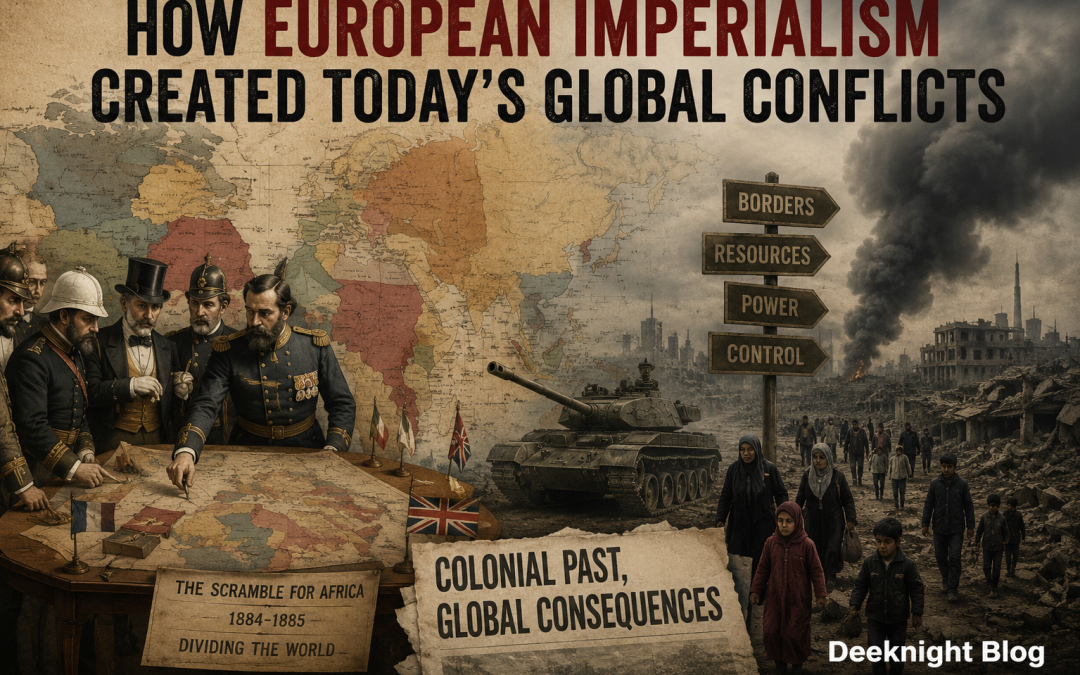
When you look at the modern world the first thing you notice is conflict. From the Middle East to Africa from Asia to Eastern Europe wars and tensions never seem to end. Most people blame religion or culture or bad leaders. But the real root of these problems goes much deeper. The main cause is European imperialism.
European powers spent centuries dividing and ruling large parts of the world. They drew borders, created enemies and left behind a system of exploitation that still works today. This blog will show you exactly. How European imperialism shaped today’s global conflicts. The history of Europe shows that competition between nations was always violent.
When European countries competed with one another to claim new territories they did not care about local people or existing cultures. They only wanted resources and power. This scramble for colonies changed the face of the earth forever. You can read our previous blog New Imperialism (1870–1914): The Era That Redrew the World Through Empire. To understand the timeline of this aggressive expansion. That blog covers the exact period when European colonial expansion reached its peak.
Why European Nations Expanded Across the World
Economic and Religious Drivers
European nations did not wake up one day and decide to explore the world for fun. Three main forces pushed them outward. First economic need. The industrial revolution created a huge demand for raw materials like rubber oil and minerals. Factories also needed new markets to sell finished goods. Second religious motivation. Churches wanted to convert non-believers in Asia, Africa and the Americas.
Third political competition. Every king and queen wanted a bigger empire than their neighbor. These were the main causes of European imperialism. The causes of European imperialism are often misunderstood. Some people think it was just greed. But greed is only part of the story. Fear also played a big role.
Fear and Competition Among European Empires
If one country did not grab a territory another country would. This fear created a chain reaction. Within fifty years European empires controlled eighty five percent of the world’s land surface. Countries like Britain, France, Portugal, Belgium, Germany and Italy all joined the race. Each one wanted to prove it was the strongest.
This competition was not peaceful. Wars broke out in Africa and Asia as European armies fought each other and local populations. The entire continent of Africa was divided without any regard for existing kingdoms or ethnic groups. European empires expanded with brutal efficiency. They used advanced weapons and superior organization to crush any resistance.
The Scramble for Colonies and Global Competition
Technology and the New Imperialism
The scramble for colonies reached its highest point between 1880 and 1914. Historians call this period new imperialism. Unlike earlier forms of expansion, new imperialism was faster, more brutal and more organized. New technology made it possible. Machine guns allowed small European armies to defeat much larger local forces. Steamships allowed quick movement of troops and supplies.
The telegraph allowed instant communication between colonies and capitals. All these tools turned the scramble for colonies into a systematic takeover of the world. The Berlin Conference of 1884 to 1885 was the peak of this madness. European leaders sat in a room in Germany and divided Africa among themselves. No African leader was invited. No local boundary or ethnic group was considered.
How Borders Were Drawn on Paper
They just drew straight lines on a map. Those lines became modern borders. That is how European empires created countries like Nigeria, Kenya and Congo. The same thing happened in the Middle East after World War One. Britain and France divided Ottoman lands into Iraq Syria Jordan Lebanon and Palestine. These borders never made sense to the people living inside them.
If you want to understand how this old competition continues today read our blog Imperialism in the Twenty-First Century. That blog explains how modern intervention and neo imperialism work in the current global system. The same logic of competition still drives foreign policy. Only the methods have changed.
How Colonial Borders Created Modern Conflicts
Straight Lines and Ethnic Divisions
Colonial borders are the single biggest cause of modern conflicts. When European empires left they did not fix the mess they created. They simply handed power to local elites who agreed to protect European business interests. The borders stayed exactly as they were drawn. In Africa more than forty percent of borders are straight lines. Straight lines do not exist in nature. They exist only on colonial maps.
These borders cut through more than two hundred ethnic groups. The same tribe now lives in two or three different countries. This creates endless fights over land resources and political representation. Take the Middle East as an example. The conflict between Israel and Palestine has many layers but the core goes back to European imperialism.
The Balfour Declaration and Middle East Chaos
Britain promised the same land to two different peoples. The Balfour Declaration of 1917 promised a Jewish homeland. At the same time Britain had promised independence to Arab leaders. This double game created a wound that still bleeds today. You can read more about this in our blog Why Is the Middle East Always at War. That blog explains in detail how colonial legacy keeps the entire region unstable.
Rwanda is another painful example. Belgium ruled Rwanda for decades. Belgian colonists favored the Tutsi minority over the Hutu majority. They gave Tutsis better jobs, better education and political power. They even created identity cards separating Tutsis from Hutus. When Belgium left the hatred was already deep. In 1994 that hatred exploded into a genocide that killed eight hundred thousand people in one hundred days. All of this started with colonial policy.
The Connection Between Imperialism and Today’s Wars
Civil Wars and Artificial States
The connection between colonialism and modern conflicts is not hidden. You just have to look at any war today and trace its borders back fifty or one hundred years. Most civil wars in Africa and Asia started because colonial powers created artificial states. These states had no shared history, no common language and no national identity. When the European empires left these states collapsed into violence. Somalia Congo Sudan Nigeria and Myanmar are all examples of this pattern.
How imperialism shaped the modern world goes beyond borders. Imperialism also created economic dependency. European empires built railroads and ports but only to take resources out. They did not build industries that could help local economies grow. After independence former colonies remained stuck as raw material suppliers. They sell cheap minerals and buy expensive finished goods.
Economic Dependency and Weak States
This unequal relationship keeps them poor and weak. Weak states cannot control their own territories. Weak states become breeding grounds for militias, warlords and terrorist groups. Our blog From Nicaragua to Ukraine: What 40 Years of US Intervention Teaches Us. Discusses how foreign intervention in the modern era follows the same imperial logic. Whether it is the United States in Latin America or Russia in Ukraine the pattern is the same.
A powerful country uses its military and economic power to control a weaker country. The language changes but the behavior does not. Imperialism in the modern world looks different from the old version but the results are the same. Old imperialism used direct rule and colonies. New imperialism uses puppet governments, economic sanctions and military bases. The goal is still control. The victim is still the local population.
Media Power and Modern Political Narratives
How Empires Used Propaganda
Power cannot survive without justification. European empires understood this very well. They built powerful media machines to sell imperialism to their own people. Newspapers, magazines and books described colonized people as backward and savage. They claimed that European empires were bringing civilization and progress. This lie made the violence acceptable. Most ordinary Europeans believed they were doing a good thing.
Today the same trick works. When Western countries bomb a country in the Middle East or Africa the media calls it humanitarian intervention. When a non Western country does the same thing the media calls it aggression. The language changes public opinion. Wars that would be unpopular become popular because of the right words. You can see this clearly in our blog Media Propaganda – Why War Coverage Fails. That blog breaks down exactly how news outlets shape your views on war.
Colonial Thinking in Modern Politics
Modern political narratives also carry the ghost of imperialism. The idea that some countries are mature and responsible while others are chaotic and dangerous comes straight from colonial thinking. Western leaders still talk about the white man’s burden but now they use words like responsibility to protect. The belief has not died. It has only changed its clothes.
Every time a powerful country invades a weaker country for its own good the imperial logic repeats itself. The media repeats the justifications. The public accepts the narrative. And the cycle continues. Breaking this cycle requires understanding how media and power work together. Our blog on media propaganda gives you the tools to see through these narratives.
Can the World Move Beyond Imperialism?
Learning Real History
This is the most important question. Can the world ever move beyond the damage of European imperialism? The answer is yes but only with serious effort. First people must learn the real history. Most schools still teach a softened version of colonialism. They talk about exploration and discovery instead of theft and murder. Changing education is the first step.
Second, the global economic system needs reform. International institutions like the IMF and World Bank were created by powerful countries for powerful countries. Their policies often hurt poor nations. A fair system would give every country an equal voice. Third, diplomacy must replace military intervention. Wars never solve the problems that imperialism created. They only make them worse.
Practical Solutions and Anti Imperialist Revival
Our blog A Realistic Path to Peace: Rethinking War Power and Global Responsibility offers practical solutions. That blog argues that peace is possible but only when powerful countries accept responsibility for their imperial past. Without accountability there can be no trust. Without trust there can be no lasting peace.
There is some good news. A new generation is waking up. Young people around the world are learning the truth about European imperialism. They are questioning the narratives their parents believed. They are building movements for justice and equality. You can see this in our blog! An Anti-Imperialist Revival in Today’s Political Discussion. That blog covers how youth and student movements are bringing anti imperialist ideas back into the mainstream. This revival gives real hope for a different future.
Conclusion
European imperialism is not just a chapter in a history book. It is a living force that shapes every major conflict today. From the borders of the Middle East to the wars in Africa from the economic inequality of the global south to the propaganda in our media the fingerprints of imperialism are everywhere. The scramble for colonies created a world of winners and losers. The winners still control the game. The losers still pay the price.
But change is possible. It starts with honest history. It continues with fair policies. It ends with a global system based on respect not domination. The anti-imperialist revival shows that people are ready for this change. Now it is time to act.
FAQs
Q: What is the main cause of modern global conflicts?
A: The main cause is European imperialism which drew artificial borders and created economic dependency. Most of today’s wars in Africa and the Middle East trace back to colonial era decisions.
Q: How did colonialism create borders in Africa?
A: European leaders at the Berlin Conference of 1884 drew straight lines on a map dividing Africa without consulting locals. These borders cut through ethnic groups and still cause violence today.
Q: Why is the Middle East always in conflict?
A: The Middle East conflict largely stems from colonial promises like the Balfour Declaration where Britain promised the same land to Jews and Arabs. These artificial borders and broken promises created permanent instability.
Q: What is the difference between old imperialism and new imperialism?
A: Old imperialism used direct colonies and military rule while new imperialism uses economic sanctions and puppet governments. Both systems aim to control weaker countries for the benefit of powerful ones.
Q: Can the world ever recover from the damage of imperialism?
A: Yes but only through honest education and economic reform. The growing anti imperialist revival among youth shows real hope for a fairer global system.