The future of 2026 is at a decisive point where the notion of peace and justice is no longer a far off dream but a pressing reality that is defining the daily lives of people. In various parts of the world, the number of conflicts is on the increase even as economic pressure is taking its toll in the lives of millions of individuals who struggle to keep their heads above water.
Climate issues are too real to be forecasts but observable interruptions that are transforming the way society lives and survives. Simultaneously there has been a rapid development of awareness through the availability of digital and world communication. Individuals are more knowledgeable yet they are also more worried about tomorrow.
This change has left a new form of urgency in which debates on peace and justice should not just be theoretical and move to real and practical aspects of change which can really make a difference in lives.
The Shifting Significance of Peace and Justice.
The definition of peace in the modern global world does not merely imply the lack of war. It has turned into a wider concept encompassing social stability, economic stability and equal opportunities of every individual.
Justice is not only limited to the courtrooms and legal systems. It speaks of the level of fairness in the treatment of people in their lives and the presence of access to the basic rights and opportunities. The absence of these factors creates tension in the society and lack of trust in institutions starts to develop.
That is why in 2026 peace and justice are closely interrelated. Without justice the peace would be transitory and unstable whereas without peace justice would find a hard time settling and growing through communities.
The Importance of Peace and Justice Like Never Before.
The value of peace and justice has been enhanced by the intricate dynamics influencing the contemporary world. The economic inequality has been rising with many people experiencing an increase in living costs and opportunities are scarce.
Climate change has further exerted pressure especially on those communities who already have limited resources and support systems. Meanwhile as technology is rapidly evolving not all people are gaining the same benefits as such a process generates a digital divide that puts access to education and development in the hands of the privileged.
These are intertwined problems that affect each other in a very strong manner. Social unrest can be caused by economic stress and displacement and instability brought about by environmental issues. A combination of these factors points to the fact that peace and justice are the keys to building a balanced and sustainable future.
Major Challenges in 2026
The escalating disparity among various economic classes is one of the most urgent problems that still contributes to an imbalance within the societies. Others are striving so hard but failing to make ends meet and this causes frustration and lack of confidence in the systems that are supposed to offer assistance and justice.
Climate related problems are also posing new types of injustice because vulnerable communities are in the worst position where they contribute least to the issue. Such an imbalance creates tension and underlines the necessity of equitable solutions.
The other major difficulty is disparities in access to technology and access to digital resources. Whereas there are people enjoying advanced tools and information, others are hampered by inaccessibility which is a direct determinant of the education career opportunities and general development.
Political separation is also becoming more apparent as the societies are becoming more polarized. Rather than open communication most conversations become conflict leading to some strife in establishing familiarity and teamwork.
All these challenges are complex and lead to the need to have awareness and persistence in order to ensure that peace and justice is realized.
Between Awareness and Real Action.
There has been a change in the manner in which individuals interact with issues touching on peace and justice over the last few years. Awareness and opinions that people wanted to share were the main topics of previous conversations but in 2026 the readers seek something deeper and more practical. They would like to know how change is possible and what can be done to change the existing situation.
This change is an indication of a wider movement whereby information is no longer sufficient. Human beings are looking to be guided in ways that would translate to practical effect. Solution-oriented and action-oriented content is currently more applicable and useful in motivating engagement and value creation.
Recommended Stories
For readers who want to explore deeper perspectives on global conflicts peace efforts and social movements the following topics offer valuable insight and context
How Imperialism Shapes Modern Wars Lessons from History and Literature
Bridging US Social Movements and the Path to Peace
A Realistic Path to Peace Rethinking War Power and Global Responsibility
Is Peace Possible in the Middle East A Realistic Path After the Gaza War
Peace Building by Everyday Action.
Peace has been seen as a common large scale initiative by the governments and organizations but the basis of peace is in the daily activities of people. The manner in which individuals express themselves and relate to one another is quite important in the minimization of the conflict and establishment of understanding.
Giving respect to someone through listening and empathy through responding can build stronger relationships in communities. Minor activities like sponsoring local projects or attending local debates can help to create a more balanced and peaceful situation.
Such attempts might seem easy but they have a long term effect when done regularly with time.
The Strength of Teamwork.
Although personal action is essential, group action can make a significant and permanent change. People unite around a set of values they can influence systems and create awareness of issues that matter.
The history of social movements demonstrated that a unified voice may be used to oppose inequality and demand justice. This is the same in the year 2026 where communities still form and strive to be treated fairly and given equal opportunities.
Collaboration enables people to multiply their effect and develop solutions that would solve more global societal issues.
Enriching Comprehension with Reading.
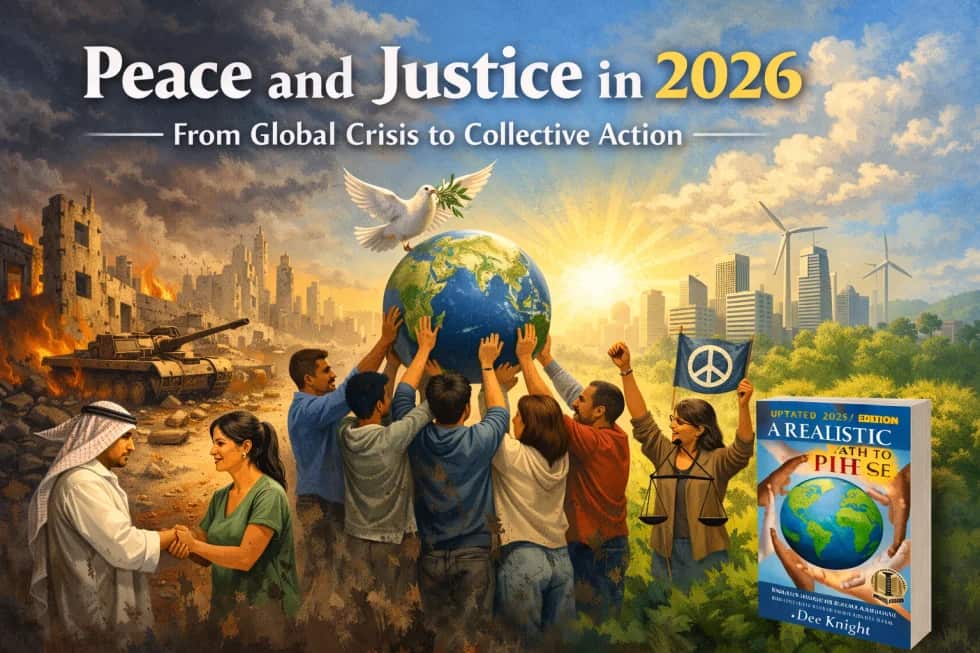
To people who want to deepen their understanding and do something significant, Dee Knight suggests a helpful book, A Real Path to Peace, which demonstrates that everyday decisions and community projects will help to establish peace in the long run.
This book is a source of inspiration and practical information on taking the awareness and converting it into a practical peace-building initiative.
What The Future Relies On.
Peace and justice in the future are contingent upon the present decisions and actions. The refusal to address the present challenges is likely to cause more divisions and instabilities whereas proactive actions can make the world more balanced and inclusive.
To make progress, one does not need everything to be perfect but it does need dedication and continuity. Tiny steps which are done frequently can bring a big change and a platform on which peace and justice can be nurtured together.
Conclusion
The future of creating a stable and sustainable future is possible with peace and justice in 2026. The problems that plague the world are intricate yet they have solutions. The most significant difference is the desire to go beyond awareness to action and responsibility both at the individual and collective levels.
Communities can make a difference through practical actions, which can be achieved by working together. It may not be an easy road but it can be done with the help of regular efforts and mutual dedication.
FAQs
Q: What is the main focus of A Real Path to Peace?
A: It shows practical steps individuals and communities can take to build lasting peace.
Q: Who is Dee Knight?
A: Dee Knight is a peace advocate and author who guides readers on actionable ways to foster harmony.
Q: Can small daily actions really make a difference?
A: Yes, consistent small efforts like listening, empathy, and community involvement have long-term impact.
Q: Is this book suitable for group projects?
A: Absolutely, it provides strategies for teamwork and collective peace-building.
Q: Where can I read A Real Path to Peace?
A: You can get it through Dee Knight’s official site or local bookstores.