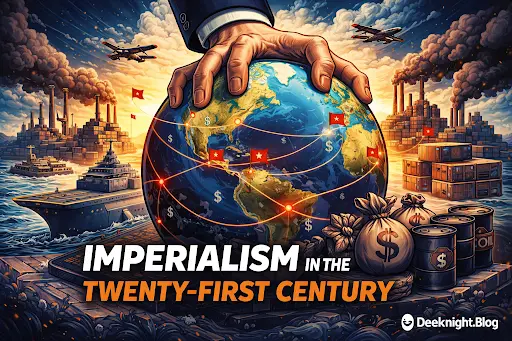

Understanding the world today requires looking beyond national borders to see how global strategies influence our daily lives. From the shift in political strategies in ongoing wars to the growing list of social movements in the United States today a clear thread connects international ambition to local resistance.
Defining Modern Imperialism in the 21st Century
While historical empires relied on direct colonization, modern day imperialism operates through economic pressure, technological dominance and strategic military placement. We see modern day imperialism examples. In the way global superpowers control trade routes and resource-rich regions without ever raising a flag.
Unlike the past, modern imperialism often disguises itself as stability operations or debt-based diplomacy. This military imperialism serves to maintain a global hierarchy that prioritizes corporate and political interests over human rights. When we analyze imperialism in the modern world we see that it isn’t just about land; it is about controlling the narrative of progress and power.
The Cost of Conflict: War and Imperialism
The relationship between war and imperialism remains as strong as ever. Recent escalations, such as the tensions surrounding a potential Iran war highlight how imperialist wars are often sold to the public as necessary for security. However the political strategies in ongoing wars frequently reveal a deeper desire to secure energy corridors and geopolitical leverage.
As these conflicts drain national treasuries they directly impact the domestic landscape. The resources spent on overseas expansion are resources diverted from education, healthcare and infrastructure fueling the very social issues in United States communities that we see today.
Recommended Stories for Deeper Insight
If you are interested in exploring the historical roots and current realities of these global shifts. We recommend these essential reads from the Dee Knight Blog archives:
- On Global Conflict: From the Strait of Hormuz to South Asia: How Global Conflicts Are Reshaping World Peace
- On Humanitarian Crisis: Israel’s Blockade on Gaza: A Humanitarian Crisis Under International Law
- On Activism: My Whirlwind Lives: Lessons from Decades of Activism and Resistance
- On Diplomacy: Befriending China: A Complete Guide to People-to-People Peacemaking
- On Regional Tensions: Under the Shadow of the Iran War, Israel Finds Another Way to Punish Gaza
The Response: Social Movements in the U.S. Today
The American people are not an inactive viewer. It is an indication of increased awareness of such global and local atrocities in the United States by the emergence of social movements. The environment-oriented current reform movements and groups that demand economic equity have never been more connected than nowadays.
The current social movements we witness, such as those advocating for peace and racial justice, are direct responses to systemic failures. These recent social movements utilize digital platforms to organize and challenge the status quo, making social movements in the u.s. today a formidable force for policy change.
Bridging the Gap: Social Issues and Reform
When we look at current social issues in America, we cannot ignore the influence of global policy. Social issues in the United States today—ranging from the housing crisis to the erosion of civil liberties—are often exacerbated by a “war economy.”
Key current social concerns include:
- Economic inequality driven by military spending.
- The impact of recent movements on local legislative changes.
- The struggle for transparency in foreign intervention.
As Dee Knight frequently explores in his writings, the path to true peace requires addressing both the “empire” abroad and the inequality at home. In his books, such as “My Whirlwind Lives“ and “A Realistic Path to Peace“, Knight provides a first-hand account of how activism can challenge current examples of imperialism and foster genuine human connection. His work serves as a roadmap for anyone looking to understand recent movements through the lens of lived experience and dedicated struggle.
A Future Beyond Imperialism
The change in our perspective on our role in the world is a step that we need to take to address the current social issues. We can start to break down the frameworks of modern day imperialism by sponsoring the social movements in the US who focus on diplomacy and not destruction.
It is either by joining the existing reform movements or learning about the history of imperialist wars, each action counts. It is aimed at progressing towards a society where social movements in the United States will result in structural, sustained change, so that the present day social issues are not transformed into the tragedies of tomorrow.
FAQs
Q1: What are some modern day imperialism examples?
A: Modern day imperialism examples include debt-based diplomacy, corporate resource control, and technological hegemony used to influence sovereign nations without direct colonial rule.
Q2: How do social movements in the U.S. today address global issues?
A: Social movements in the U.S. today link domestic inequality to military imperialism, advocating for shifting tax dollars from foreign wars to local social reform.
Q3: What defines military imperialism in the 21st century?
A: It is defined by the strategic placement of overseas bases and political strategies in ongoing wars designed to secure energy corridors and geopolitical leverage.
Q4: Why is peace advocacy critical for current social concerns in America?
A: Peace advocacy is critical because it challenges the “war economy” that drains resources away from essential current social concerns like healthcare, housing, and education.